|
MSC Cruises United States Grand Prix
Click here for a large map of the circuit
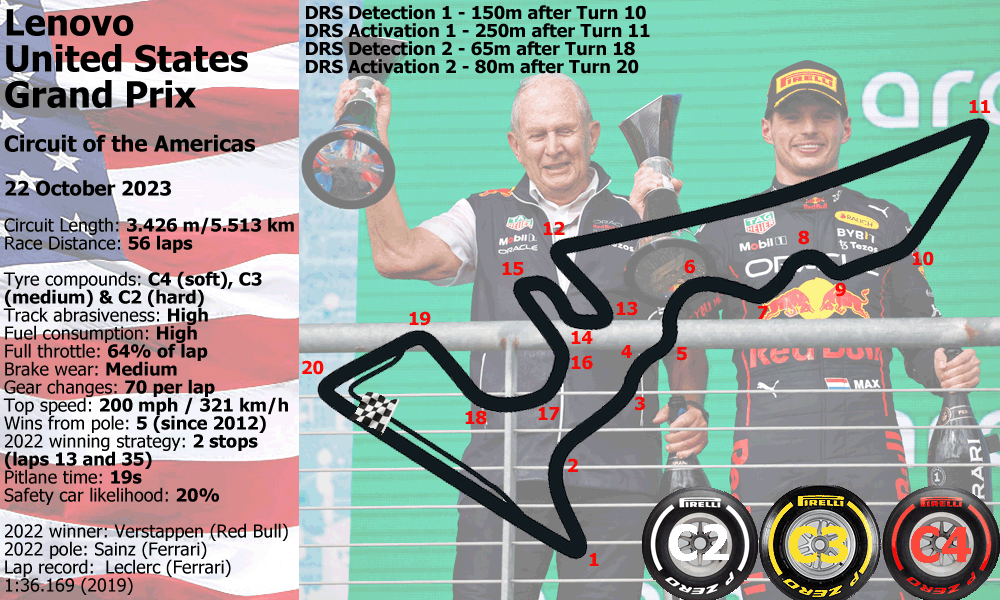
From a driver perspective
Designed to evoke the majesty of corners such as Maggotts and Becketts and Istanbul's Turn Eight, there are many highlights across a lap of the Circuit of the Americas.
Blasting along the start/finish line at 300km/h (186mph), drivers are met with the first key moment of the lap: an incline to Turn One that's steeper than Spa's Eau
Rouge/Raidillon.
Braking starts while driving uphill, and the entry is largely blind, meaning it's easy to lock-up. The sharp-left corner then tightens, offering multiple points of attack and
defence, but the narrowing exit can be a flashpoint in the race.
Next up is the slaloming high-speed run through Turns Two to Six, which is inspired by the Maggotts-Becketts-Chapel complex at Silverstone, taken at an average of roughly 260km/h (162mph). Entry speed, finding the flow, and throttle precision are key to this section.
Turns Seven and Eight are modelled on Interlagos's Senna Esses, and Turn Nine ends the quickfire right-left transitions.
The circuit begins to open up when drivers reach the elevation change of Turn 10, which is followed by a hairpin and then the longest straight on the circuit at 1,016
metres. It's one of the best overtaking spots on the lap, and boosted with DRS ahead of a hard braking zone conducive to passing.
The slower and technical Turns 13 to 15 evoke Hockenheim's Stadium Section. It begins with a hard-braking point, with speeds dropping to as low as 97km/h (60mph).
Turns 16 to 18 are modelled on Istanbul's Turn Eight. It's a sweeping multi-apex corner where any errors are compounded in lap time due to the length of the corner.
Turn 19 is the last challenge of the lap, where running wide is often punished with lap time deletions or in-race warnings, before the final corner brings the drivers back onto the start/finish line to end the lap.
DRS Zones
There will be two DRS zones at COTA again this year.
The detection point of the first is 150m after Turn 10, with activation 345m after Turn 11.
The second zone's detection point is 65m after Turn 18, with activation 80m after Turn 20, on the start/finish straight.
Changes for 2025
The walls at Turns 1 and 20 have been realigned.
From a power unit perspective
Just under 60% of the lap is taken at wide open throttle, rising to over 60% in qualifying. The average speed will be a touch over 125 mph (200kph) with top speed peaking at over 200 mph (320kph).
Since gradient changes a lot over one lap, engine speeds and turbo rotation vary constantly, and settings must be constantly adjusted to give optimal performance.
After the first corner the driver goes back up through the gears to reach seventh for turns 2, 3 and 4, which are taken flat out with an average speed of 168 mph (270kph). Similar to Maggots and Becketts at Silverstone and the Esses at Suzuka, the driver needs to be precise on the throttle and carry the speed all the way through rather than brake and accelerate. The power unit needs to be correspondingly smooth throughout the turns, delivering constant levels of torque.
The low ambient humidity of the Texan grasslands has a big effect on the power units. The air will contain more oxygen and the ICE will generate more power, but the aridity is very taxing on the internals. We will watch ignition timing very closely.
Similar to Abu Dhabi, the longest straight is not the pit straight. In Austin it is the burst between turns 11 and 12, which is 1,016m. The car will be at full throttle for almost 12secs. It will also spend over two seconds at maximum velocity at the end of the straight. The driver will brake heavily at the end of the straight for the hairpin so rear-end stability and stability under braking will be crucial.
From a tyre perspective
It's time once again to unfurl the Stars and Stripes as Formula 1 heads to Austin, Texas this weekend. For the event at the Circuit of the Americas, on the calendar since 2012, the teams will have a trio of compounds that features an extra step between the Hard and the Medium-Soft pair. It will be an interesting experiment to see if this could lead to a greater choice of strategies on one of the most complete tracks on the calendar.
The Compounds
The United States Grand Prix will be the second race of the season for which Pirelli is bringing three non-consecutive compounds, the last time being Spa-Francorchamps and the available tyres will once again be the C1 as Hard, the C3 as Medium and the C4 as Soft. In Belgium, bad weather meant it was not possible to find out how this choice might have affected strategy and so the event in COTA could be the first real test of this choice, which sees the use of a harder Hard than last year at the American track, while the Medium and Soft are the same.
The increased performance difference between the hardest compound and the middle one should, theoretically, give rise to two scenarios. If drivers prefer the C1, the slowest but also the most consistent of the three, then they could run a one-stop race combining it with the C3. On the other hand, using the latter along with the C4, with its improved resistance to degradation, would produce quicker lap times but would almost certainly require two stops. Another similarity with the Belgian round is that Austin is also running to the Sprint format, which means teams only have one hour to try the various options over long and short runs, which could add to the uncertainty as to how the weekend might pan out.
In 2024
15 drivers started last year's race in Austin on the Medium tyre, including the trio that made it to the podium, while the remaining five went with the Hard C2. The Soft was never really an option on race day, with only Alpine's Esteban Ocon fitting it on the last lap to pick up a precious extra point in its battle with Williams, for setting the fastest time.
The most popular strategy was a one-stop, with only a handful of drivers on a planned two-stop, as well as Albon who had to pit after just three laps. Although the Medium showed significant signs of wear in the Sprint, in the main event drivers managed to extend the stint with careful management, helped by a Safety Car period, despite the weight from being on full tanks. Less graining than on the previous day also made the one-stop more effective.
The Track
The Grand Prix at the Circuit of the Americas is run over 56 laps in an anticlockwise direction. The 5.513 kilometre-long track boasts 20 corners, incorporating sections reminiscent of legendary Formula 1 circuits, with corners taking inspiration from Silverstone's Maggots-Becketts sequence, Suzuka, Hockenheim, and even Istanbul Park's famous layout. One of its most distinctive features is a 41metre elevation change, most noticeable with the steep climb immediately after the start line. The variety of corners requires a versatile set-up that can provide top-end speed while still ensuring stability through the more technical sections.
Tyre loading is evenly balanced across the front and rear axles, but lateral forces are greater than longitudinal ones due to the many high-speed corners and rapid direction changes. Tyre degradation is typically thermal in nature and is also influenced by ambient temperature, which can still be quite high in Texas in October. Last year, during the race, the mercury rose above the 30°C mark and next weekend looks set to be similar. The track was partially resurfaced last year, making it smoother and less bumpy than in the past.
Track Evolution
During last year's Austin race weekend, track evolution played an important role. This phenomenon refers to the progressive increase in grip that the track surface provides the more laps the cars run, not only within each session but also throughout the entire weekend. This is due to the rubber left by the tyres on the track surface, which makes the circuit faster, leading to a constant reduction in lap times. Track evolution also affects tyre behaviour, making them less prone to sliding and degradation. This was one of the reasons why last year at COTA, drivers were able to extend their stints on the Medium compound further than suggested by data from the Sprint race, completing Sunday's race with just one pit stop.
Statistics Corner
The United States Grand Prix is the second round on the calendar in the USA after Miami with Las Vegas still to come. Over the year, the event going by this name has visited six different venues: from the inaugural 1959 race in Sebring to the 45th edition held in Austin. However, with 12 races held here, COTA is not the circuit that has hosted the most editions, as that record goes to Watkins Glen (New York), which staged 20 Grands Prix between 1961 and 1980. The famous Indianapolis Motor Speedway hosted eight races between 2000 and 2007, while four editions took place on the Detroit street circuit (1985-1988) and three in Phoenix (1989-1991). Sebring, in 1959, Riverside, the following year, and Dallas, in 1984, each hosted just one race.
Lewis Hamilton holds the record for the most wins (five in Austin and one in Indianapolis), just one fewer than Michael Schumacher (who won five times at Indianapolis). The two are tied for pole positions with four apiece. Hamilton also clinched two of his world titles in Texas, his third in 2015 and his sixth in 2019. As for the constructors, Ferrari holds the record for the most wins on eleven: two at Watkins Glen, five at Indianapolis, and four in Austin.
Fast Facts - Provided by Mercedes
• COTA is one of nine tracks on the 2025 F1 calendar that is fully anticlockwise, alongside Jeddah, Miami, Imola, Baku, Singapore, Interlagos, Las Vegas, and Yas Marina.
• It is tied with Baku for the second-most corners on any F1 2025 track, with 20, behind Jeddah (27).
• The incline from the starting grid to the apex at Turn One is 134 feet, one of the highest elevation changes on the whole F1 calendar.
• No one has more wins at COTA than Lewis Hamilton (5). Lewis also clinched his third (2015) and sixth (2019) F1 titles at the track while with Mercedes.
• Mercedes has five wins at COTA - more than any other Constructor. Lewis has four of those, while Valtteri Bottas also has one US GP win, coming in 2019.
• For the third year in a row, the circuit will hold an F1 Sprint race on Saturday.
• In 2025, as in 2024, COTA will host the fourth of six F1 Sprint races during the season.
• COTA has been the home of the United States Grand Prix since 2012.
• The 2025 United States Grand Prix will be the 500th for Mercedes-Benz as the official Safety Car, having debuted at the 1996 Australian Grand Prix and first been deployed at the 1996 Belgium Grand prix.
|