|
Tag Heuer Grand Prix de Monaco
Click here for a large map of the circuit
From a driver perspective
Picking a highlight around a lap of the Monaco Grand Prix is no easy feat, but few corners require more of a specialist approach than the Fairmont hairpin.
This is the slowest corner on the F1 calendar, taken at speeds as slow as 48km/h (30mph) at a hairpin so tight that teams and drivers run a modified steering rack to cope with what often feels like a traffic jam on the opening laps.
Another unique challenge is the run from Turns Nine to 11, which encompasses drivers blasting out of the tunnel section into the blinding sunlight, requiring drivers to trust in their car and muscle memory.
Once drivers readjust, the Nouvelle Chicane looms. This tricky left-to-right complex has become a possible overtaking point, but the barriers have claimed many drivers' races in recent years.
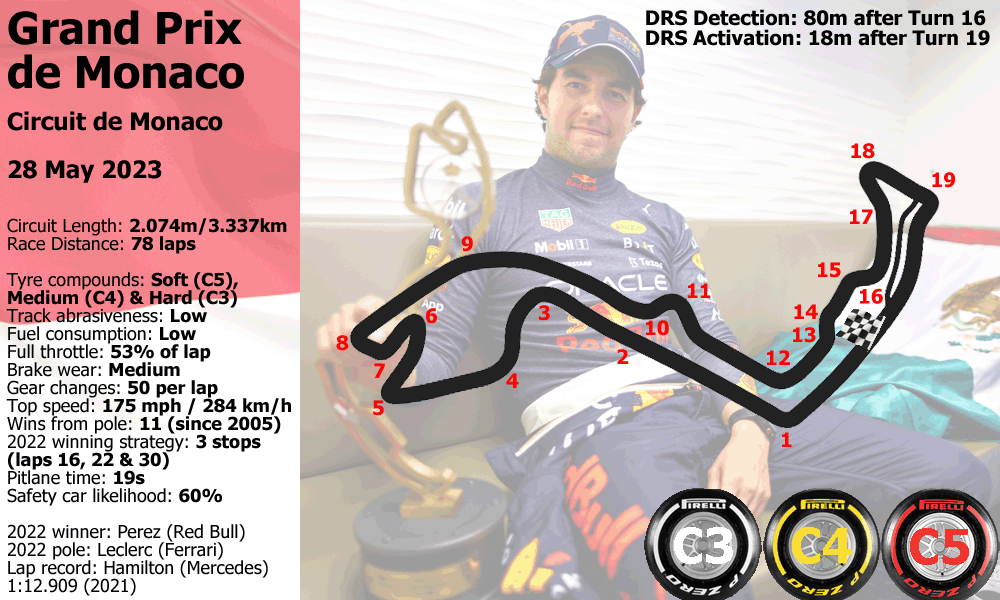
DRS Zones
There is one DRS zone.
Detection is 80 metres after Turn 16
Activation is 18 metres after Turn 19
Changes for 2025
The track has been resurfaced from Turn 12 until Turn 13.
From a power unit perspective
Monte Carlo has the lowest average race speed on the calendar at just 150kph. Top speed peaks at only 290kph.
Less than 30s - roughly one third of the lap - is spent at full throttle, which places an emphasis on the overall package's driveability rather than outright performance.
The tunnel section and pit straight are the only chances to hit maximum speed.
Monaco is a very bumpy circuit with lots of camber change. This can induce drops in oil pressure as the oil pumps aren't able to properly scavenge the oil system, or the oil tank succumbs to an unexpected loading. A temporary lack of oil pressure can be harmful to the turbo as lubrication is vital at the speeds at which the turbo operates.
Energy recovery is easy with the amount of braking points - the 19 corners are all taken at an average of less than 100kph and the MGU-K will have more than enough opportunity to recharge the ES.
Since energy recovery under braking is relatively easy, Monaco is one of the few races of the year where fuel consumption won't be critical, particularly as the overall race distance is so short and there is so little time spent at full throttle.
Grand Hotel (or Loews) Hairpin. The track descends from the Mirabeau and turns almost 180 degrees back on itself in front of the hotel. When the cars round the hairpin the engine is running at just 45kph and around 4,500rpm, the lowest speed and revs it reaches on track at any point in the year.
From a tyre perspective
The Monaco Grand Prix is one of the most iconic and prestigious events on the Formula 1 calendar, not just because of its long history, but also because of the mystique that surrounds it. It was first held in 1929, making it one of the sport's oldest races and it is also part of what's known as motor racing's Triple Crown, along with the Le Mans 24 Hours and the Indianapolis 500 Miles. Narrow streets, tight turns, steep climbs and descents and the famous tunnel that leads onto the harbour are some of the defining characteristics that make Monaco a track like no other. It's a place where precision is more important than power, with virtually no room for mistakes.
Apart from the actual racing, the Monaco Grand Prix is a unique social event, a mix of sport, elegance and glamour, generating an atmosphere all of its own. From a technical point of view, it is a very complicated race: the cars run with maximum aero downforce and with very limited overtaking opportunities, qualifying generally plays a key role in determining the winner. Ultimately, Monaco is much more than just a race, it's a symbolic celebration of the purest and most spectacular essence of Formula 1.
Once again, the drivers who make it to the podium will wear a special edition of the classic Pirelli Podium Cap, designed by Denis Dekovic and featuring the colours of the Monegasque flag.
For a second consecutive race, Pirelli has selected the three softest compounds from the 2025 range. As in Imola last week, the C4 will be the Hard, the C5 the Medium and the C6 the Soft, with the first two being the mandatory compounds for the race.
This weekend will see an important change to the regulations, specifically for this event only. During the race, two pit stops will be mandatory (for a full explanation see the "Keyword" section below).
The aim of the FIA and F1 is to inject more excitement into a race that has often been very linear and predictable, as was very much the case last year (see specific section below).
As part of this rule change, each driver will also be allocated an additional set of Full Wets, on top of the usual two, so that the two-stop rule can be applied even if conditions require the use of extreme wet tyres.
It will be interesting to see how this affects teams' race strategies. For example, with no clear pit-stop windows, it could present opportunities for drivers starting from further back to move up the order by making the most of running in clean air.
Having two stops should also rule out concerns about tyre degradation, even if it is in any case very low at this track. It could even lead to the use of the Soft compound, especially for those making a late second stop or in the case of a Safety Car period in the closing stages.
In the Monaco Grand Prix drivers usually pit just once to change tyres, but last year, out of a theoretical field of 20, only six drivers made an actual in-race pit stop. That was because the race was red flagged on the opening lap so that all the drivers still in the race were able to immediately adhere to the rule that two different compounds must be used, with the nine who started on the Medium switching to Hard and the remaining 11 doing the opposite. After the restart, only six drivers actually pitted under racing conditions. Of these, Guanyu Zhou opted for Softs but clearly gained no performance advantage as he was still last. It made for a dull race, with the top ten taking the chequered flag in grid order.
Winding its way through the streets of the Principality usually open to normal traffic, the track is 3.337 kilometres long and tackled 78 times in the race. Very narrow with 19 corners, some of them very tight, there are virtually no run-off areas and the barriers are so close that the drivers often brush against them, as they strive to use every available inch of road.
Around half the track has been resurfaced, specifically from turn 12 to turn 3, so that this section should now be as smooth as the rest of the circuit. This type of surface does not promote tyre grip and could lead to graining, especially in the first couple of practice sessions. Then, as the racing line gets rubbered-in, the situation should improve, while bearing in mind that the track is reopened to road traffic at the end of each day.
Keywords: Sporting Regulations
The sporting regulations were recently modified to require two mandatory pitstop for this race. The specific rule is Article 30.5, paragraph m. Here is a synopsis of its content.
"...For the Monaco race, each driver must use at least three different types of tyre (either dry or wet). If a driver does not use intermediate or wet tyres in the race, they must use at least two different slick tyre compounds, of which one must be from the mandatory dry compounds (Hard or Medium). Unless the race is suspended and cannot be re-started, failure to comply with these requirements will result in the disqualification of the relevant driver from the race results. In this case thirty seconds will be added to the elapsed time of any driver who did not, when required to do so, use at least two specifications of dry-weather tyre during the race, or who did not use at least three sets of tyres of any specification during the race. Furthermore, an additional thirty seconds will be added to the elapsed time of any driver who used only one set of tyres of any specification during the race."
The Monaco Grand Prix was the second round of the 1950 season, the inaugural year of the Drivers' World Championship. It saw the first appearance of Scuderia Ferrari, the only team to have taken part in every edition of motor racing's blue riband series. The Italian marque heads the field when it comes to World Championships (15 Drivers' and 16 Constructors'), wins (248), pole positions (253), fastest race laps (263) and podium finishes (830).
There have been 70 Monaco GP to date, as it was off the calendar from 1951 to 1954 and in 2020. The "Prince" (the four-wheeled variety) of Monaco is Ayrton Senna with six wins, followed by Graham Hill and Michael Schumacher on five. The Brazilian also holds the record for the most pole positions (5) and podiums (8).
McLaren is the most successful team in the Principality with 15 wins, followed by Ferrari on ten, while Lotus and Red Bull Racing are joint third with seven. The team from Maranello has the most poles (13), with McLaren second (11) and Lotus third (9). Ferrari also tops the table for podium finishes with 57, more than double the number of second placed McLaren on 28, with Lotus again third on 16.
Almost half the winners (32, equivalent to 45.71%) started from pole. If one considers that a further 16 winners (22.68%) started from second on the grid, it is easy to understand why Saturday's qualifying is so crucial to doing well on Sunday. However, in 1996, Olivier Panis delivered an exceptionally rare feat by winning from 14th on the grid!
Fast Facts - Provided by Mercedes
• The race sees the highest lap count of any event with 78 tours of the circuit forming the Monaco Grand Prix. It is the only race that does not adhere to the FIA's mandated 305 km minimum distance, measuring 260.286 km.
• A tighter and narrower pitlane than most F1 tracks means Monaco is one of three circuits to run a pitlane speed of 60 km/h, rather than the usual 80. The other two are Zandvoort and Singapore.
• Monaco, along with Jeddah, has the most number of right hand turns on the F1 calendar with 11.
• For this 82nd edition of the Monaco Grand Prix, a two-stop strategy will be mandatory for all teams.
• The softer C4, C5, and C6 tyre compounds will be used at the streets of the Principality, one step softer than last year.
• From the seven races in F1's inaugural 1950 season, only four of them remain on the calendar in 2025: the British, Monaco, Belgian and Italian Grands Prix. All four races take place on the same circuits they did in 1950: Silverstone, Circuit de Monaco, Spa-Francorchamps, and Monza.
• The first-ever Monaco Grand Prix was organised in 1929 by Antony Noghes. The final corner of the circuit is named in his honour.
• The 1996 event holds the record for the F1 race with the fewest finishers. Only podium scorers Olivier Panis, David Coulthard, and Johnny Herbert finished the race.
• Mercedes-Benz Power has won 12 of the last 25 Monaco Grand Prix, with McLaren, Brawn and Mercedes.
• With three victories around the streets of the principality, Lewis Hamilton is the most successful driver on the current grid at the Monaco Grand Prix with three wins (2008, 2016, and 2019). Fernando Alonso and Max Verstappen have two wins, Charles Leclerc has one.
|