|
Pirelli Grand Prix du Canada
Click here for a large map of the circuit
From a driver perspective
Finding the braking point into the left-hander of Turn 1 is really important, as you then switch straight back into a very tight right-hander at Turn 2. Running too deep through the first will ruin your line into the second, which will lose you a lot of time. You have to be mindful of the kerbs through here as they can throw the car off balance quite easily, while the exit of Turn 2 also has very low grip. It's a tricky section of track to start the lap and one which quite often sees incidents: particularly on the first lap.
The first of many chicanes around the circuit comes at Turns 3 and 4. You have to take plenty of kerb through the corner and then run wide, right up against the wall, on the way out. It's so very to get that wrong. The next chicane at Turns 6 and 7 is a bit tighter and slower, but good exit speed is crucial for the straight which comes up afterwards. This leads you down into another chicane at Turns 8 and 9, where you quite often see overtaking.
It's so important to carry good speed once again to give you a good run down into the stadium complex at Turn 10, where you find the biggest crowds of fans during the weekend. It's a really tight right-hander and you want to brake as late as possible: running deep into the corner and making a 'V' shape to get the best exit possible down the crucial back straight.
The straight itself seems to go on forever and you also have DRS available for the second time around the lap. Looking into the distance it's so hard to pinpoint your braking point before you clip the kerbs, do your best to avoid the infamous 'Wall of Champions' and put the power down across the start / finish line.
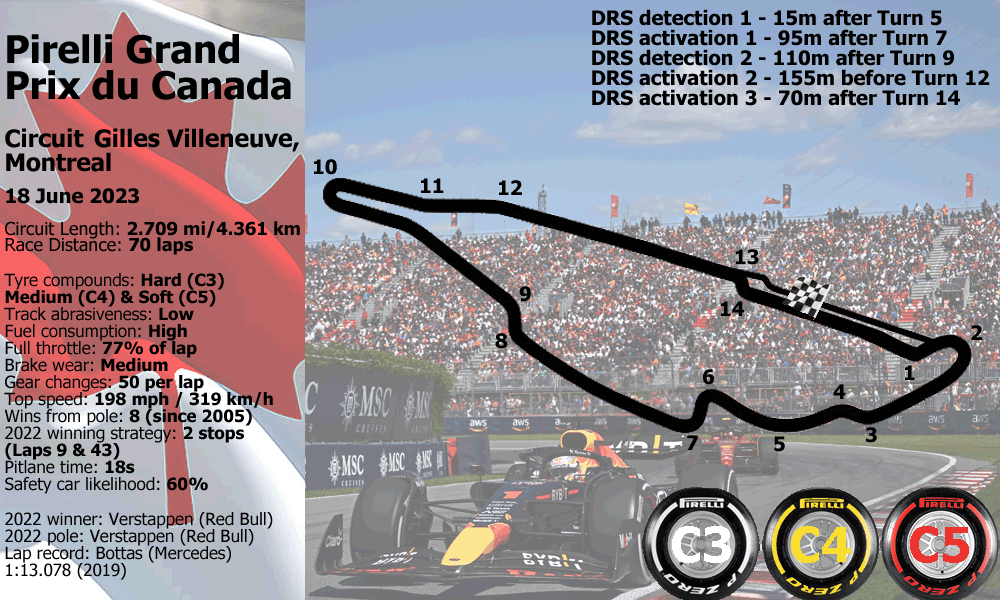
DRS Zones
As in 2024, there are 3 DRS Zones.
The first zone has a detection point 15m after Turn 5 and an activation point 95m after Turn 7.
The other two zones share a detection point 110m after Turn 9, with activation points 155m before Turn 12 and 70m after Turn 14.
Changes for 2025
Drainage has been improved at Turns 2, 8, 10 and 13 by making small cuts in the kerbs.
The track surface has been ground down in Turn 12 in the area prior to the DRS line in order to remove a bump.
The run-off behind Turn 8/9 apex had been regraded and a paved path has been created.
Realignment of the white line at Turn 3 and Turn 8, with 1.5 metres to the wall.
The concrete wall at the right-hand side of Turn 10 has been extended.
From a power unit perspective
Montreal is the toughest challenge of the year so far for the Power Units. The long straights demand maximum power for just over 60% (63% in qualifying) of the lap. The longest straight on the circuit is the Droit du Casino at 1,064m and top speed will be in excess of 330kph, the highest speed seen this year so far.
Nine of the ten corners are taken at less than 150kph, but each of them is quickly followed by a stab on the throttle. His rapid braking-acceleration sequence calls for accurate power delivery and good turbo response.
The hairpins at Turn 10 and Turn 2, plus the chicane leading into the Wall of Champions, are extremely heavy braking points. Engine braking assists with the braking demands to slow the car to a low of 60kph.
There aren't enough braking points on the circuit to allow the K to recover the full FIA allowable amount. This, along with the high fuel consumption at this track, makes for a delicate balancing act during the race to stay within the 105kg permitted fuel load.
Montreal's demands on the MGU-H are the polar opposite of those of Monaco. In Monte Carlo the MGU-H was barely used; in Montreal the duty cycle is extreme.
From a tyre perspective
The Canadian Grand Prix is the tenth round of the season, the second in North America after Miami. Montreal is one of the staples on the calendar, for many years the only round in this part of the world. It is popular with drivers and teams because there's always a real buzz around the event thanks to the enthusiasm of the local fans. For the whole week, the city in the Province of Quebec comes alive with events linked to the Grand Prix.
Once again, the top three finishers will wear a special edition of the Pirelli Podium Cap designed by Denis Dekovic when they step up for their trophies.
The compounds
For the third time this season, the softest trio of compounds will feature on track. That means, after appearing for the first time in Imola and again in Monaco, the C6 will be in use, alongside its closest relatives, the C5 as Medium and the C4 as Hard. The selection is therefore one step softer than last year when the chosen compounds were the C3, C4 and C5.
This weekend, when using the new C6, teams and drivers will be able to make the most of the information and data gathered at its two previous appearances. The Gilles Villeneuve Circuit is a track where the lateral forces exerted on the tyres are medium to low, while the longitudinal ones are a bit more severe, although not particularly high, because of the cars being subjected to strong deceleration followed by sharp acceleration. The track surface is very smooth and not very abrasive and is never used for racing apart from the Grand Prix weekend. Graining, especially during free practice on Friday, could put in an appearance, but as the track gradually rubbers-in it shouldn't be a factor. Lap times come down really quickly, not just from one day to the next, but also during each session.
On top of that, the unpredictable and changeable weather is a factor to consider, a wildcard that's been known to disrupt the on-track action here, while fluctuating temperatures are a feature of the Montreal event.
In 2024
The race got underway on a wet track. 18 drivers opted to start on Intermediates, while the Haas pair went with extreme wets. Indeed, Magnussen and Hulkenberg provided the show in the early stages of the race, as the blue banded Pirelli Cinturato offered excellent grip in these conditions, so that both drivers were able to charge up the order, with the Dane even making it as high as fourth place by lap 3, having started 14th. However, the track was drying out rather quickly and so the American team's two drivers were the first obliged to pit for Intermediates, as their lap times had slowed considerably.
Then, in the second part of the race, the green-banded Pirelli Cinturato was the tyre to have, as conditions alternated between rain and sunshine with the track drying, especially on the racing line, before getting wet again following another shower. The majority of drivers made the most of the first Safety Car period, forty minutes into the race, to switch to a second set of Intermediates, while a trio made up of Ocon, Tsunoda and Bottas, gambled on their tyres lasting long enough to extend the stint until the track was fit for slicks. Sauber's Finn went to lap 42, while Alpine's Frenchman and Racing Bulls' Japanese driver waited a further two laps. These three were the only drivers to complete the seventy lap race with only the one pit stop.
When slicks were viable, the majority (14) of drivers chose the Medium, thus looking for a better warm-up phase, while five went with the Hard, thinking more about wear, armed with the knowledge that in free practice, the Medium had suffered with graining.
The track
The Gilles Villeneuve Circuit is a semi-permanent facility built on the manmade island of Notre Dame, on the Saint Lawrence river, which was home to the Expo '67 World's Fair and some events in the 1976 Olympic Games.
The track was completely resurfaced last year, but it has retained its low abrasiveness and reduced grip that has always been one of its characteristic features. 4.361 kilometres long, it features a sequence of straights and tight chicanes, with 14 corners (six to the left and eight to the right). It's a real stop 'n go track where stability under braking and efficient traction are vital.
Overtaking is possible, partly down to the three DRS zones. The best bet has always been the braking point at the end of the straight that takes the drivers back to the start. The following chicane, where drivers can still use DRS from the previous activation zone, has often seen some spectacular accidents, which has led to it being known as the "wall of champions" after no fewer than three world champions, Damon Hill, Michael Schumacher and Jacques Villeneuve all crashed into it during the 1999 race.
Keyword: Water
Apart from being surrounded by the waters of the Saint Lawrence river and running alongside an artificial rowing basin used in the 1976 Olympic Games, the Canadian Grand Prix is one of the races that is most often affected by rain. As previously mentioned, during last year's race both types of wet weather tyre were used.
At every race weekend, Pirelli supplies each driver with five sets of Cinturato Green Intermediates and two of Cinturato Blue Full Wet. The former can disperse up to 35 litres of water per second at a speed of around 300 km/h, while the Full Wets can deal with up to 85 litres per second.
The Cinturato Full Wet was updated this year, with the tread blocks given greater rigidity so as to generate less heat in the tread pattern. The construction has also been revised to deal with the higher aerodynamic loads generated by the current cars, making the tyre less prone to overheating and thermal degradation. Development testing means the new Full Wet offers an improvement in performance, bringing it slightly closer to that offered by the Intermediate, while maintaining the same water dispersal values to tackle any eventual risk of aquaplaning.
It's also worth noting that, since 2023, the Full Wets can no longer be pre-heated, while the temperature of the blankets for the Intermediates is set at 60 °C.
Statistics corner
This year's event will be the 54th Canadian Grand Prix, with the first one dating back to 1967. The race has been held at three venues: prior to Montreal, it has been run at Mosport, around a hundred kilometres from Toronto and at the Mont Tremblant ski resort, 145 kilometres from Montreal.
Michael Schumacher and Lewis Hamilton top the tables for the most wins with seven apiece and most pole positions with six. With four to their name, Schumacher and Kimi Raikkonen lead the way for fastest race laps, with the German out on his own when it comes to podium finishes with 12. The most successful team is McLaren on 13, followed by Ferrari (12) and Williams (7).
The 2011 race is in the record books as the longest Grand Prix ever in terms of time, having lasted for four hours, four minutes and 39.537 seconds. It featured six Safety Car appearances, but the biggest factor in this record was a very long red flag period due to torrential rain, because a regulation that had been in force since 2005 meant that the race clock was not paused during stoppages. Eventually, Jenson Button, who had been last on lap 37, won the race for McLaren!
Fast Facts - Provided by Mercedes
• The 4.361 km Circuit Gilles Villeneuve is similar in its characteristics to that of the Baku City Circuit in Azerbaijan. Long straights requiring lower drag are punctuated by slower speed corners such as chicanes and hairpins that require higher downforce.
• The 14 corners of the circuit comprise six left-hand and eight right-hand turns. Most of the corners are in a similar speed range, which is at the lower end of the scale compared to the rest of the circuits on the 2025 calendar.
• This will be the 44th F1 Grand Prix to take place at the Circuit Gilles Villeneuve. Only Spa, Silverstone, Monaco, and Monza have hosted more.
• Several corners come as a double change of direction (left/right or right/left combinations) that require good responsiveness from the car. These include the combinations that comprise turns one and two, turns three and four, turns six and seven, turns eight and nine, and the final chicane at turns 13 and 14.
• The 405-metre pit lane ranks eighth in terms of length across all the circuits we race at. However, time expended during a pit stop is not especially high, as drivers are spared the inconvenience of going through the last chicane, instead entering the pit lane directly. Additionally, the pit exit feeds in at Turn two, thus drivers avoid having to negotiate the first corner too.
• The Circuit Gilles Villeneuve is traditionally regarded as tough on brakes, similar to the Austrian GP. However, there are usually fewer cooling problems in Canada than in Spielberg because the lap distance is greater and there is more time for the brakes to dissipate temperature.
• The wall on the exit of the final corner has been dubbed 'The Wall of Champions' ever since 1999, when Damon Hill, Michael Schumacher, and Jacques Villeneuve all had their races ended at the turn through crashes.
• Along with Miami, Austria and Las Vegas, Montreal has the most heavy-braking zones on the F1 calendar with three.
• Lewis Hamilton and Michael Schumacher share the record for the most wins at the Circuit Gilles Villeneuve with seven.
• The circuit is located on the Île Notre-Dame, an island that hosted the World Expo in 1967. The Expo 67 American Pavilion, which became the Montreal Biosphere and is now an environmental museum, is a visible reminder of this.
• The man-made body of water outside the track - which drivers cross over to get into the paddock - was built to host the rowing and canoeing events at the 1976 Summer Olympic Games.
|