|
Heineken Dutch Grand Prix
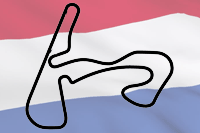
Click here for a large map of the circuit
From a driver perspective
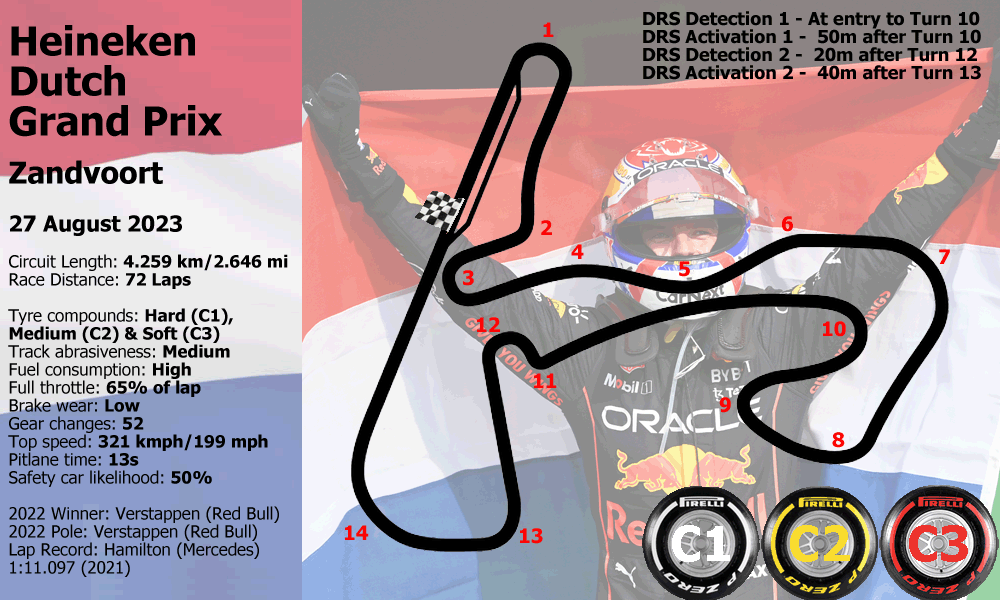
A lap of Zandvoort begins with a short run to Turn One, where drivers hug the inside line and get on the power early towards the banked left-hander that is Turn Three. It's all about getting a good exit onto the following straight for Turns Four and Five, which are flat out.
Turn Seven requires a small lift off the throttle and sparing use of the exit kerbs, which can throw the car off balance under acceleration. Turn Eight is another rapid right-hander that signals the start of a low-speed sequence.
Trail-braking into Turn Nine, drivers are briefly back on the throttle before reaching Turn 10 which leads into the second DRS zone of the lap and a hard-braking zone into Turns 11 and 12. The lap concludes with a cambered right-hander at Turn 13 and a steeply banked, flat-out final corner that sees drivers accelerate down the start-finish straight.
DRS Zones
There are two DRS zones
Detection for zone 1 is at the entry to Turn 10, with activation 50 metres after Turn 10
Detection for zone 2 is 20 metres after Turn 12, with activation 40 metres after Turn 13
Changes for 2024
The pitlane building has been extended by six garages.
The barriers have been realigned in Turn 6 on the right-hand side.
New concrete walls with FIA fencing have been installed between Turn 10 and Turn 11 on the right-hand side.
From a tyre perspective
Formula 1 is back in action at a track that presents one of the most complicated challenges of the season. The Dutch Grand Prix takes place at the classic Zandvoort circuit, nestled in the dunes on the North Sea coast, having been updated just a few years ago to host Formula 1, starting in 2021 after an absence of 36 years. It has retained its original characteristics including its twisty layout featuring 14 corners, four to the left and ten to the right, over the course of its 4.259 kilometres. But what makes this track really unique on the championship trail are the banked turns 3 and 14, with a gradient of 19 and 18 degrees respectively, which for a point of reference is steeper than that found at Indianapolis.
Banked corners are not that common in Formula 1 and therefore present an unusual challenge for both car and driver. It also has an effect on the tyres, because the higher speeds of the banked turns compared to the normal ones subjects them to even greater forces. That explains why the dry weather compounds chosen for Zandvoort are the three hardest in the 2024 range, used since the introduction of the 18" tyres: C1 as P Zero White hard, the C2 as P Zero Yellow medium and the C3 as P Zero Red soft.
On paper, thermal degradation is a very significant factor, but much will depend on the weather in late August. The Netherlands borders Belgium and we saw before the break how climatic conditions at these latitudes can change from one day to the next and even within the space of a day, so that summer doesn't necessarily mean warm temperatures and sunshine. The average temperature in Zandvoort in late August varies between 14 °C and 20 °C, which could help drivers manage even the softest compounds, as was seen in last year's race when Tsunoda ran 50 laps on the Soft. A further variable results from the track's proximity to the sea shore, just one row of dunes and a street away, so that wind often coats the track with sand, thus lowering the grip available to the tyres.
Conditions changed so much during last year's race that all five types of available tyre were used. The most popular slick was the Soft, chosen for the start by 19 of the 20 drivers, Hamilton being the only one to opt for the Medium. The rain arrived immediately after the start, bringing the Cinturato Intermediate into play, and it was then required again for the final stages, after a long spell where slicks were used. Three drivers, the Red Bull pair and Esteban Ocon, even tried out the Cinturato Wet. There were a lot of overtaking moves and a record 82 pit stops.
In stable dry conditions, pre-event simulations point to a one-stop as the quickest strategy, especially as in theory, overtaking is a rare event, because the track is very narrow and there are few straights, therefore very limited passing opportunities. If it is hot, then the harder compounds should be favourite, but cooler weather would see the Soft become a viable race tyre.
The Zandvoort circuit has hosted all 33 editions of the Dutch Grand Prix counting towards the Formula 1 World Championship, dating back to 1952. Scotland's Jim Clark won here four times, a record that could be equalled this year by Max Verstappen who has won all three races since Formula 1 returned to the Netherlands. In Saturday's qualifying, the Red Bull driver could also top the table for pole positions here, as he is currently equal with René Arnoux on three. When it comes to the most podium finishes, this record is also held jointly by Jim Clark and Niki Lauda with six apiece. Among the teams, Ferrari leads the way for wins (8) and podium finishes (25) while, on eight, Lotus has the most pole positions.
Fast Facts - Provided by Mercedes
• In general, Zandvoort has an old-school feel, with fast and flowing turns, a mix of corner speeds, undulations, gravel traps and banked turns. It puts many aspects of an F1 car to the test.
• Zandvoort is nestled in the rolling sand dunes and next to the beach on the West coast of the Netherlands. The main straight is the closest part to the coast and the back section winds its way through the dunes.
• Because of the many high-speed changes of direction, where the mass of the car can work against you, Zandvoort has the highest mass sensitivity of the year - which means, carrying more fuel will be more penalising.
• Zandvoort has one of the quickest lap times of the season and is the second shortest circuit in length after Monaco.
• The 72-lap race distance is the second most on the calendar (also after Monaco).
• It is the third highest track for downforce sensitivity, which means maximum or very high downforce is required. The only two tracks that rank higher than Zandvoort are Budapest and Monaco.
• The Zandvoort pit lane is one of three on the calendar to have a 60 km/h speed limit, rather than the usual 80. The other circuits are Monaco, and Singapore.
• For 2024, the pit building in Zandvoort has been extended by six garages.
• The Dutch Grand Prix returned to the F1 calendar in 2021 after a 36-year absence.
• F1 legend Niki Lauda took the last of his 25 wins at Zandvoort in 1985.
• Zandvoort is one of only three tracks on the F1 2024 calendar that Lewis Hamilton has not yet claimed victory at. The other two are Miami and Las Vegas. He is aiming to extend his record of most different F1 circuits won at to 32 in 2024.
|