|
Aramco Magyar Nagydij
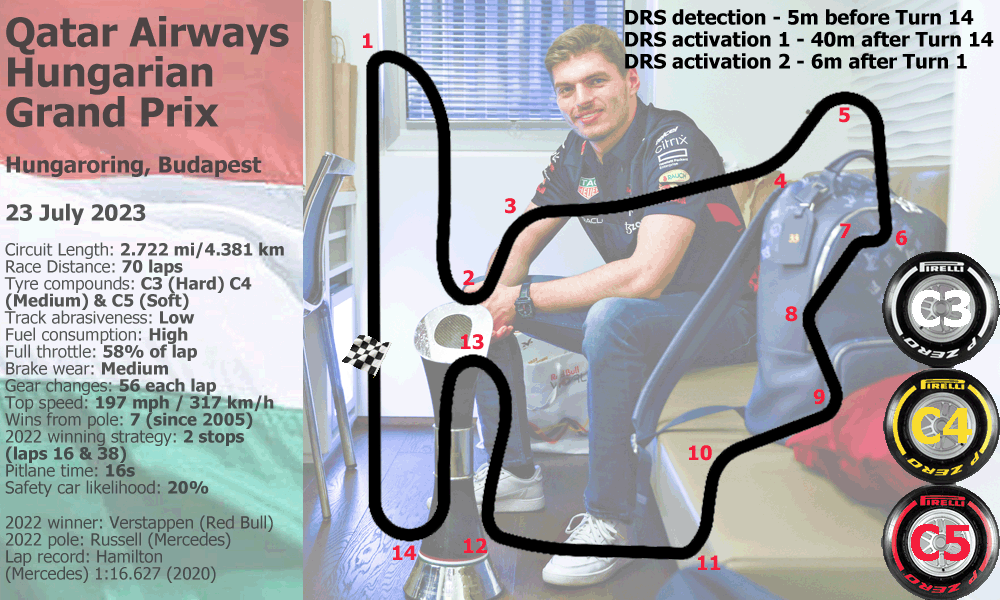
Click here for a large map of the circuit
From a driver perspective
Hungary is one of the least power-dependent circuits on the Formula One calendar, prioritising set-up and high downforce. Feeling planted in the car is the key to a quick lap because a single mistake can ruin a lap. From a dusty track surface on a Friday to on-the-edge driving on Sunday, the Hungaroring is a unique challenge. Our official Cyber Security Partner SentinelOne presents the key technical facts and stats behind a single lap of the track.
The main straight is of average length on the Formula One calendar, but drivers still hit 320km/h (198mph) before heavy braking at the 70m mark into a sharp, right-angle third-gear corner, the best overtaking spot of the lap.
Drivers will maintain speeds of 100km/h (62mph) as they start to unwind the steering wheel and stamp the accelerator, shifting towards the right-hand side of the track ahead of Turns One and Two.
Turn Two is a downhill bend and a slow corner, around 120km/h (74mph). The key is to keep a tight line, moving towards the apex on the inside before progressively leaning towards the outside on exit. Running wide is costly, and drivers can end up chasing the lap time around the remainder of the circuit.
Drivers then immediately arrive at the kink of Turn Three, a higher-speed corner taken in fifth gear at 230km/h (142mph). The run to Turn Four is the second-longest straight on the circuit, beginning with a slight downhill run before a steep incline.
Turn Four is the second-fastest corner of the lap, requiring focus and commitment. Drivers maintain speeds above 240km/h (149mph) as they dart left and prepare for a slow and technical second half of the lap.
The long hairpin of Turn Five is all about setting up the entry. Carry too much speed, and you'll run wide, losing time, which is then compounded on the short straight that follows.
Drivers arrive at the Turns Six and Seven chicane at 250km/h (155mph), braking hard down to 110km/h (68mph), which is then followed by the medium-speed and sweeping Turn Eight.
Then there's a swift change of direction at Turn Nine, a sweeping right-hander. The average speed is around 160km/h (99mph), and drivers slalom through the two corners to keep momentum.
Turn 10 is a barely noticeable kink before the all-out Turn 11, taken completely flat as the fastest corner on the circuit, driven in sixth gear and at 260km/h (161mph). After that free-flowing section, it's back to classic Hungarian Grand Prix technical twists as drivers drop all the way down to second gear at Turn 12.
The deep right-hander is then followed by the slow Turn 13 hairpin, a real challenge for drivers to maximise because the tyres drop off late in a one-lap shootout or long into a race stint. There's one last challenge for the drivers as they reach the last corner, Turn 14. A good exit is key to set up the next lap, and drivers use the full width of the circuit to maximise it.
DRS Zones
Once again there are two consecutive DRS zones.
They share a detection point 5m before Turn 14.
Activation points are 40m after Turn 14 and 6m after Turn 1.
Changes for 2022
There have been no changes of significance since the last event.
From a power unit perspective
The Hungaroring is not considered a power sensitive track since one lap is taken at just 55% full throttle. The average speed is just over 195kph during qualifying, with each corner taken from second to fourth gear.
The turbo is highly solicited in Hungary. The driver is constantly on and off the power and having a turbo that can kick in instantly with accurate power will greatly reduce lap time by improving driveability. Sector two is critical for turbo response since the corners are mid to low speed, with rapid braking events. Delivering power when needed is important to overall lap time reduction.
The heavy braking zones will provide the K with the opportunity to recover energy. The main energy recovery points for the MGU-K will be the first corner, where the cars will brake from almost 310kph to under 90kph, and almost the entirety of sector two. Turns six and seven (the chicane) in particular feature another heavy braking zone that gives further opportunity to recover energy.
The MGU-H is really put through its paces in Budapest, possibly more so than at any other circuit so far this year. This is due to the small bursts of power between the corners which are very intense.
Ambient temperatures are expected to be hot, with the mercury well over the 30 C mark. Advanced cooling and heat dissipation strategies are to prevent overheating.
From a tyre perspective
The Hungarian Grand Prix marks the halfway point of the year before the summer break, and Pirelli has chosen the tyres in the middle of the range: C2 as the P Zero White hard, C3 as the P Zero Yellow medium, C4 as the P Zero Red soft.
The Hungaroring has a reputation for being extremely hot and dry: track temperatures during free practice last year peaked at nearly 60 degrees. But the reality is that it's actually rained just before the race for the past two seasons in Hungary. Last year that led to a somewhat surreal re-start following a first corner incident, when Mercedes driver Lewis Hamilton was the only person to get going on intermediates from the grid, while everyone else went into the pit lane for slicks.
The Hungaroring isn't a particularly high-energy circuit, with smooth asphalt that's sometimes bumpy in places, and the demands on tyres being more about traction than braking.
{b}Mario Isola:{/b} "In the past, the Hungaroring has been known as a place where it's difficult to overtake, but the new package of cars and tyres this year helps drivers get much closer to each other, which is why we have seen some great races with plenty of overtaking so far this season. Hopefully that's going to be the case at the Hungaroring as well; a tight and twisty track where the cars are often grouped together. Hungary is also known for being very hot, but it's also rained for the last two years there: so the moral of the story is never to jump to conclusions! We've seen some surprises at the Hungaroring before, and that could be the case even more this year."
Fast Facts
• The Hungarian Grand Prix usually turns out to be one of the hottest race weekends of the year, with air and track temperatures averaging 27°C and 43°C respectively.
• The Hungaroring was resurfaced several years ago, and most of the bumps were flattened out. However, given this was a little while ago, the track surface is gradually starting to show its age and the irregularities are forming again.
• The amount of braking activity, the high ambient temperatures and the absence of any truly long straights make this track exceptionally taxing on the brakes. Furthermore, the lack of overtaking opportunities mean drivers can get stuck in traffic. The low average speed at the Hungaroring also limits the airflow, all of which makes it even harder to cool the brakes.
• Six of the Hungaroring's 14 turns are left-handers and eight are on the right. Many of these corners are combined, making good directional changes more important.
• The straights at the Hungaroring are relatively short and taking the corners at the right speed is crucial. Consequently, the standard setup for Hungary includes maximum downforce.
• Due to its nature as a high-downforce track, the Hungaroring has one of the lowest top speeds of the season so far: 308 km/h. The F1 cars only go straight for about ten seconds during the course of a fast lap, spending the remaining 65 seconds or so cornering.
• Although the home straight in Hungary is one of the shortest on the racing calendar, the distance from pole position to the braking zone for Turn 1 is one of the longest of the year at 444 metres, a distance exceeded only by Mexico City, Imola, Barcelona and Monza.
• The track characteristics are also reflected in the full-throttle percentage, with only 65% of the lap distance on the Hungaroring taken with the accelerator pedal to the floor - one of the lowest ratios in Formula One.
• The kerbs in the final corner can be very aggressive, and the same applies to the exit of Turn 11. However, unlike on faster tracks such as Spielberg a few weeks ago, the kerbs in Hungary are driven over at lower speeds. The chicane (Turns 7 and 8), on the other hand, can prove problematic, especially in the wet, and take the drivers by surprise.
• Good traction is very important when negotiating the many slow corners, which is why this circuit puts the rear tyres in particular under a lot of stress.
• The strategy in Hungary is often on the borderline between a one-stop and a two-stop race. If the tyres 'fall off a cliff' towards the end of a stint, the driver can suddenly lose an enormous amount of time.
Fast Facts - From The FIA
This is the 37th FIA Formula One World Championship Hungarian Grand Prix. The race made its debut in 1986 and has run uninterrupted to the present day. All of the races in Hungary have been held at the Hungaroring. Monza is the only track with a longer run of consecutive grands prix.
Lewis Hamilton is the most successful driver at the Hungarian Grand Prix, with eight victories - twice the number of Michael Schumacher, who is the next driver on the list. Hamilton won three times with McLaren (2007, 2009, 2012) and five for Mercedes (2013, 2016, 2018-'20). No driver has ever won a Formula 1 race nine times.
McLaren are the most successful team in Hungary with 11 victories. Alongside Hamilton's three wins, they have enjoyed victories with Ayrton Senna (1988, 1991-2), Mika Hakkinen (1999-2000). Kimi Raikkonen (2005), Heikki Kovalainen (2008) and Jenson Button (2011).
Kovalainen's victory was his first in F1, a record he shares with two of the current grid. Fernando Alonso took his maiden win in Hungary, in 2003, and Esteban Ocon, Alonso's current team-mate at Alpine, did the same last year. The other drivers to take a maiden victory at the Hungaroring are Damon Hill (1993) and Jenson Button (2006).
Button's victory in the rain-affected 2006 race came from 14th on the grid, the furthest back from which the race has been won. Traditionally a difficult circuit on which to overtake, the race has been won from the front row 22 times.
The other drivers in the current field to win the Hungarian Grand Prix are Daniel Ricciardo, in 2014 for Red Bull, and Sebastian Vettel, in 2017 for Ferrari.
At the 2019 Hungarian Grand Prix, Max Verstappen took the first of his 16 pole positions to date. Unusually for the modern era, Verstappen had seven F1 victories before his first pole.
Michael Schumacher has the most fastest laps at this race, with four. Two drivers on the current grid have two each. Vettel set the fastest lap of the race in 2010 and
2012, both with Red Bull, and Daniel Ricciardo was fastest in 2015 and 2018, also with Red Bull.
2022 rookie Zhou Guanyu raced here in the FIA Formula 3 European Championship from 2016 to 2018, and the FIA Formula 2 Championship in 2019 and 2020. He appeared on the podium three times in F3, finishing third in 2016-17 and second in 2018.
|