|
Toyota has a long and distinguished history of international motorsport success. In recent years the Japanese company has been most noted for its multiple victories in the World Rally Championship and CART series, backed up by strong performances in the Le Mans 24 hours classic.
However, Toyota's sporting influence has spread much further afield as it has built an impressive participation catalogue, so it was only natural that the company should finally decide to participate in the most prestigious of all motorsport events, the Formula One World Championship.
Toyota's motorsport heritage has demonstrated that with each new level of competition, it is always willing to take on a new challenge, and consequently much of 2001 was spent preparing for the team's F1 debut in 2002.
While the 2001 Formula One World Championship was unfolding, Toyota was working away at a number of test tracks around the world as the Japanese outfit prepared to emulate Ferrari by becoming the second team on the grid to produce its own chassis and engine.
The 2001 test programme was gruelling and on one occasion Toyota actually ran a 'dummy' Grand Prix weekend complete with practice sessions, qualifying, race and press conferences!
In Mika Salo and Allan McNish the team went for experience. The Finn, a veteran of 93 races with a number of teams including Lotus, Tyrrell, Sauber and Ferrari was joined by GP 'rookie', but former McLaren tester and Le Mans winner, McNish, who 1976 World Champion James Hunt had previously tipped as a future F1 Champion.
The result in Melbourne might possibly have been the worst possible for the Japanese team, for Salo's sixth place flattered to deceive.
McNish looked set for a point in Malaysia too until a 'botched' pit stop put an end to his dream, while another point in Brazil together with some impressive qualifying performances indicated that the team might prove to be a force to be reckoned with, but it was not to be.
The problem was that this was Toyota's first season and all the 'dummy' GPs in the world couldn't prepare the outfit for the real thing. The Japanese team was slow to react to problems and its development was virtually non-existent compared to its rivals.
Late in the season, as the cars slipped further and further down the grid, Toyota shocked everyone by revealing that both drivers were to be dropped at the end of the season. It's to their credit that neither McNish nor Salo 'eased off' in their final races, indeed the Scot came close to paying the ultimate sacrifice in a horrendous qualifying crash at Suzuka.
Although Toyota will say that 2003 was a marked improvement on its debut season, the truth is that the TF103 failed to live up to expectations. Although Luca Marmorini and his team had produced a solid, powerful engine, the chassis simply wasn't up to the job. Almost from the moment the season got underway, the Japanese outfit was rumoured to be looking for a new designer, with Renault's Mike Gascoyne at the top of the 'wish list'.
Drivers Olivier Panis and Cristiano da Matta did a good, solid, workmanlike job, as much as the TF103 would allow. The Frenchman had appalling reliability, consequently finishing only 691 of the 1018 racing laps that comprised the season.
Thanks to the interference of a deranged former priest, and the weather, the Toyotas found themselves leading the British GP, but it will be a few years before the Japanese cars are in that position solely on merit.
In late 2003 F1 was rocked by the news that the police had questioned an employee who had previously worked for Ferrari, prompting talk that the Japanese outfit had 'copied' the Italian team's 2002 car. Understandably, Toyota quickly distanced itself from the affair, though the authorities are still investigating.
Shortly after season's end, Toyota revealed that it had obtained the services of Gascoyne, though one shudders to think how much compensation Renault demanded, and clearly got. The Englishman had virtually no input as far as the TF104 was concerned and though he tried to resolve the car's many problems, his main priority was the 2005 car.
At the TF104's launch, President John Howett revealed that the team's budget had been reduced in 2004, though it is still significantly more than many of its mid-field rivals.
Panis and da Matta were retained, while former BAR driver, Ricardo Zonta, was brought in as test driver.
Even though little was expected of the TF104, pre-season testing was encouraging, and in some circles there was even talk of the team scoring its first podium. But it was not to be. Although reliability had improved, and the Toyota power-plant was clearly one of the most powerful, the TF104 was a 'dog'. Indeed, so bad were the results, the team introduced a B-spec car mid-season (Hockenheim).
By this time it was already known that Ralf Schumacher had signed for 2005, while Renault's Jarno Trulli was being linked with the second seat.
In the past, Toyota has shown that it has no time for sentimentality, therefore former team boss Ove Andersson slipped quietly out of view, before the Cologne based outfit made a number of other controversial decisions.
On August 5, just days before the Hungarian GP, it was revealed that Zonta was to replace da Matta for the rest of the season. Although the former CART champion was to be 'retained', it was clear that his F1 career was at an end. Days later, the team revealed that Team Manager, Ange Pasquali, was to leave, as was General Manager for race and test engineering, Norbert Kreyer. The company described the cull as 'streamlining'.
In mid-December, it was revealed, after months of speculation, that Trulli would indeed join Ralf Schumacher in 2005, though just weeks later, in a move which caught almost everyone off guard, the Italian left Renault and slipped into the second white and red car, for the last two races.
Much was expected of the TF105, indeed many reputations, if not Toyota's entire F1 programme, rested on the car.
From the outset, it was clear that Mike Gascoyne's first car for the Japanese manufacturer was a serious leap forward, and those who thought Jarno Trulli's front row grid slot in Australia, or the subsequent podiums in Malaysia and Bahrain, were in for a surprise.
Though the TF105 was never likely to challenge either the McLaren MP4-20 or the Renault R25, it was, along with the Ferrari, the best of the rest, thanks to Luca Marmorini's powerful, and highly reliable RVX-05 engine, and the ever improving work done by Gascoyne and his team.
For much of the season it was Jarno Trulli who dominated the team, the Italian particularly superb in qualifying, clearly able to 'turn it on' for one hot lap. However, when the 105B was introduced at the end of the season it seemed to suit Ralf, allowing the German to take pole in Japan.
There is no doubt that following its strong start to the season, which saw it take 40 points from the first five races, there was a definite mid-season lull. Having made the lap forward in 2005 - finishing fourth in the Constructors' Championship, the Japanese team now has to build on its success. This means continuing development throughout the season, and ensuring that both drivers give 100% at all times. Both Schumacher and Trulli are fast drivers, but they are also inconsistent and liable to lose motivation. Furthermore, there remains a serious question mark over their development abilities, which probably explains why Zonta has been retained as test driver.
Trulli, in particular, was devastating in qualifying, but often lacked any pace during races, especially during the early laps, while there were times when one forgot that Ralf was actually out there, even though he had one of the best finishing records.
Ahead of the 2005 season, the bosses at Toyota HQ were demanding a podium at the very least, and considering the Japanese team's budget, this wasn't a lot to ask for. The fact that the team had two podiums after just three races must have seemed like the team - in only its fourth season let us not forget - had won the title.
Launching the 2006 car, Toyota admitted that it was aiming to celebrate its first win during the forthcoming season, and even more optimistically hoped to be the best performing Bridgestone runner, an ambitious task considering that Ferrari was also on the Japanese rubber.
The fact that at the launch of the 2007 car Tsutomu Tomita apologised to his team's "worldwide fans and sponsors" for the "unfortunate announcement" at the 2006 launch, just about summed things up.
After the highs of 2005, 2006 brought Toyota back to earth with an almighty crash, the Japanese team finishing sixth in the Constructors' Championship, behind 'new boys' BMW.
The TF106, which was effectively a modified TF105 was a poor car, while the RVX-06 powerplant was equally lacking. Poor grip and balance, not to mention an engine that was rumoured to be 40 bhp down on the Ferrari - that's several seconds a lap - left Ralf Schumacher and Jarno Trulli struggling.
To make matters worse, at a time when the team should have been pulling together, there was internal conflict, with Tokyo HQ clearly at odds with Cologne. Just days after Schumacher scored the team's best result of the year, its only visit to the podium, Toyota revealed that it had parted company with (technical director) Mike Gascoyne, the Englishman going off to tend his begonias and hollyhocks before joining Spyker.
At the 2007 launch, Tomita, beginning to sound like an old record, repeated the battle cry, informing the assembled guests and media that his team was aiming for its first victory.
To the surprise of many - though perhaps not - both Schumacher and Trulli were retained, with former Renault tester Franck Montagny brought in as test driver.
From the outset it was clear that 2007 was going to be pretty much a repeat of 2006, indeed, despite the bold pre-season claims the team actually fell back in 2007, scoring thirteen points to finish sixth, behind Red Bull. Best results of the season were a brace of sixth-places, Trulli at Indianapolis and Ralf in Hungary.
To make matter worse, and much to the chagrin of the Japanese outfit, Williams, using the very same powerplants, finished fourth in the championship, twenty points clear of the Cologne based outfit.
What went wrong in 2007? Well, while reliability was improved, certainly on 2006, there was a basic failure to score points, an obvious understatement but in many ways the team's real failing. Unlike many of its rivals, Toyota already had experience of the Bridgestones. However, basic, stupid things such as poor starts and botched pit stops left the red and white cars of one of the best funded teams on the grid battling with Red Bull, Toro Rosso and Honda, which was having its own Annus Horribilis. Then, apart from an obvious lack of pace, certainly compared to the front runners, there was the fact that the team employed two drivers who appeared to have lost all motivation.
It came as no surprise when Toyota announced that Ralf Schumacher would not be retained for 2008, indeed there was serious speculation that he was to be dropped during the course of 2007. However, Trulli was retained and would be partnered by 2007 GP2 Series Champion, Timo Glock.
Design-wise, it was all change at Toyota in 2008, where Pascal Vasselon was joined by Mark Gillan (Head of Aerodynamics) and Frank Dernie (General Consultant). The result was a car that was more consistent and less sensitive. The TF108 also followed Ferrari's 2007 lead - don't tell Mike Lawrence - with a longer wheelbase, thereby giving better underflow and more stability.
While performance was a lot more consistent, there was still a worrying discrepancy from track to track. However, both drivers felt the car to be more stable under braking, which certainly gave the team hope and a foundation on which to build.
Next up came the aero improvements with a number of packages being introduced in the early part of the season. The third major aero package was introduced in France, and while the team celebrated a fine drive to third by Trulli, the joy turned to despair on learning of the death of team founder Ove Andersson in a historic rally accident.
While the Toyota's aero efficiency was no real match for the Renault Red Bull teams, it could compete where high downforce was paramount, enabling Glock to take a superb third in Hungary.
Easy on its tyres, the TF108 struggled at Hockenheim and Monza, however, when the team opted for aggression over conservatism the car clearly fared better.
When the front-end grip was working well it suited Trulli, hence some strong race and qualifying performances. However, when the front-end was less 'grippy' it was Glock who benefited.
In 2008, Toyota finally appeared to be heading - design-wise - in the right direction, having seemed to learn the lesson of previous seasons, particularly 2007, and also by keeping an eye on the opposition, most notably Ferrari.
However, we have seen that the Cologne based outfit is slow to learn, and therefore, with the raft of new rules in 2009 and the inability to carry the strengths of the 2008 package forward one has to wonder how the team will fare.
Of the two drivers, Glock was a revelation. Following his spectacular crash in Melbourne he appeared to fade away for the next few races before giving a convincing performance in Canada which saw him finish fourth. Then, just two weeks after the crash at Hockenheim which saw him hospitalised he qualified fifth in Hungary and went on to give Toyota its best ever result by finishing second.
Trulli also had a good season, the highlight being his extraordinary drive to third at Magny-Cours. Then there was his first lap at Spa, making up six places on the run to La Source alone.
While some were a little surprised to see the Italian veteran retained for 2009, some of his 2008 performances, not least Belgium and qualifying in Germany and Brazil, reminded us that there was life in the old dog yet.
The increasingly impressive Kamui Kobayashi was also retained as test driver, though the new even stricter test rules meant that he would see little action.
2008 wasn't too bad for Toyota, what with finishing fifth in the Constructors' Championship, its best result since 2005. However, when Honda announced in December 2008 that it was withdrawing from F1, followed by Toyota's parent company announcing its first trading loss in its history, many believed the Cologne-based outfit might be next to go.
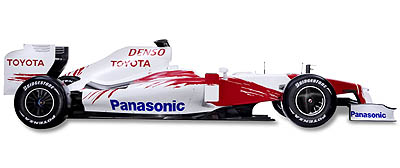
Toyota management insisted that it was a case of 'business as usual' and that it would continue with its F1 programme. However, it was clear that the team would need to make a major step forward if Tokyo was to continue picking up the tab. Indeed, at the launch of the TF109 it was as good as said, 'start winning or else'.
While in Melbourne it was Brawn that was getting all the publicity, Toyota quietly got on with the job, the Cologne-based outfit, like the Brackley team and Williams, having spotted the double diffuser loophole. Indeed, the Japanese team appeared to have its entire aero package just about spot-on.
Unfortunately, the Race Stewards in Melbourne weren't quite so sure about the TF109's aero and after qualifying ruled the rear wings illegal for being too flexible and promptly excluded the times posted by both drivers. Nonetheless, spirited drives saw Trulli finish third and Glock fourth though this result was temporarily overshadowed by what was to be known as 'Lie-gate' in which the Italian was the hapless victim.
Both drivers finished in the points in Malaysia while in Bahrain, by which time many judged the TF109 to be one of the best cars out there, Trulli and Glock locked-out the front row of the grid, albeit on light fuel loads. Sadly, the Japanese team was unable to convert this into its first victory though Trulli did score his second podium finish of the season.
A major update was introduced in Spain but this was removed after the Friday practice sessions had proved inconclusive. After that however, the team appeared to lose its way somewhat, the TF109 proving to be dramatically inconsistent.
In qualifying, Trulli regularly outshone his teammate and not always due to fuel loads. However, poor tyre choice, bad strategy and the TF109's basic inconsistency meant that the team was rarely able to capitalise. The Toyota was widely reckoned to be the third best car out there in terms of raw speed, however when all other factors were taken into consideration it fell behind the McLaren and Ferrari also.
Much like the Brawn and Ferrari, the Toyota was highly sensitive in terms of its tyres, when the TF109 got its Bridgestones working all was fine, when it didn't…
Team boss John Howett, knowing that Tokyo was watching very carefully, opted to shift blame from the car to the drivers and towards the end of the season it was clear that he was seeking an all-new line-up for 2010.
However, the inconsistency of the car, some very odd decisions by the team - most notably the removal of that aero upgrade in Spain - and Toyota's whole approach to its F1 programme played their part.
Glock experienced a long lean spell between Bahrain and Singapore, only scoring points in Turkey and Hungary, while Trulli managed points finished in three races including a fourth in Turkey.
In Singapore Glock brought a Toyota home in second place for the second time in the team's eight season career. A few weeks later Trulli equalled the feat in Japan, the fast sweeping curves of Suzuka suiting car and driver.
Japan wasn't all good news however, for an accident during qualifying ruled out Glock not only for the race but for the remainder of the season.
The media remained sceptical regarding the extent of Glock's 'injury' a situation not helped by the fact that the German actually attended the two remaining races. Waiting in the wings was company protégé Kamui Kobayashi who stepped up to the plate and manfully delivered.
Points from Trulli and Kobayashi in the final race (Abu Dhabi) saw Toyota finish fifth in the Constructors' Championship while Trulli finished eighth in the drivers' standings.
On November 4, three days after the Abu Dhabi GP, Toyota announced its withdrawal from F1 citing the global economic downturn as the main reason.
While many had expected such an announcement when it finally happened it still sent a shockwave through the sport, particularly as Toyota had only recently signed up to the new Concorde Agreement.
Within a month the team had shed 500 jobs while all three drivers found seats on the 2010 grid.
Despite media speculation to the contrary, Toyota in Tokyo announced that its F1 team was not for sale though there is continued speculation linking Serbian Zoran Stefanovic (Stefan GP) with the Cologne outfit.
Despite the huge sums invested, despite the promises, despite the fact that Toyota is the biggest and most successful car manufacturer in the world today, the Japanese company never really cut it in F1. One cannot help but feel that if it had done things differently, got really involved in an existing team, things might have been different. But that's not the Toyota way.
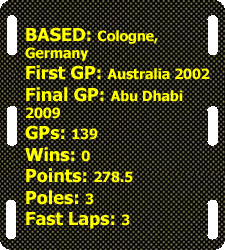
Statistics - at the end of the 2009 Season
Best result in 2009: 2nd (2 times)
Best qualifying 2009: Pole (Bahrain)
Worst qualifying 2009: 20th (Monaco)
2009: Trulli out-qualified Glock 11 times
2009: Trulli out-qualified Kobayashi 2 times
2009: Glock out-qualified Trulli 4 times
2009: Kobayashi out-qualified Trulli 0 times
2009: Completed 1721 out of 1923 laps (89.5%)
2009: Finished 29 times from 33 starts (87.9%)
|