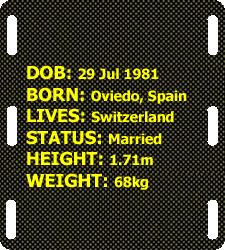
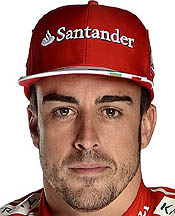
|
At a time when drivers entering F1 seem ever younger, it's worth noting that the Spaniard took part in his first kart event at the age of three!
By the age of seven he was a regular karter and by the age of twelve Fernando was Spain's Junior Karting Champion, a title he held for four years in addition to winning the World Junior Kart Championship in 1996 at the age of 15.
Progressing to Inter-A Karting, Fernando won the Spanish (twice) and Italian titles before progressing to single-seaters, the Euro-Open Movistar Nissan Championship, which he won at the first attempt, winning 6 races and starting from pole on 9 occasions.
The following season, aged eighteen he graduated to F3000, finishing second in Hungary and first in Belgium and subsequently finishing fourth in the championship behind Junqueira, Minassian and Mark Webber.
In 2001, at that time under the management of Benetton F1 boss Flavio Briatore, Alonso was signed to the Anglo-Italian outfit as test driver. However in a surprise move the youngster was loaned to Minardi with whom he made his F1 debut on March 4 at Melbourne, becoming the third youngest driver to start an F1 Grand Prix.
In hopelessly under-performing equipment the youngster was sensational, out-qualifying some of his more illustrious rivals. Sadly due to TV directors' insistence on focussing on the front-runners, much of Fernando's finest driving went almost un-noticed.
For 2002 Fernando returned to Benetton, now under the ownership of Renault, as test driver, and in mid-summer it came as no real surprise when it was announced that he would replace Jenson Button for 2003.
It wouldn't be an exaggeration to say that Fernando was the sensation of 2003, this came as no surprise to those who spotted his talent back in 2001, but made the rest of the world sit up and take notice.
Finishing third in Malaysia and Brazil followed by a fine second in his home race it was simply a question of when, not if, he would win his first Grand Prix. In Hungary the youngster went into the history books as the youngest driver to win a Grand Prix, having become the youngest pole-sitter at the start of the season in Malaysia.
For much of the early part of the 2004 season, Fernando was outshone by teammate Jarno Trulli, certainly in qualifying. Despite his undoubted bravery and ability, the youngster still had much to learn, namely his tendency to over-drive the car, in addition to his Latin temperament. One only had to look back to his 2003 accident at Interlagos which was totally needless.
In spite of his (relative) failure in qualifying, his sheer speed, and the R24's status as the ultimate in 'getaway cars', the Spaniard usually made up for his poor grid position at the start of races, mixing it with the front runners by the time they reached the first corner.
Despite a strong start to the season, Renault clearly lost ground in the second half of the year, though at times it appeared that someone had forgotten to tell Fernando. Although it was Button, and of course Ferrari, grabbing all the headlines, the young Spaniard gave some bravura performances, Japan and Brazil immediately spring to mind.
It is well documented that the mainstream media - particularly in Britain - has a penchant for building up a person, be it actor, musician or sports star - then knocking them down. And there were times, especially towards the end of the 2005 season when it seemed as though this was the case with Fernando Alonso.
The young Spaniard had driven a superb season, yet it appeared that the media, and indeed many race fans, regarded him as the villain of the piece, and was cheering for Kimi Raikkonen. Indeed, at the end of the year it was the Finn who appeared to win the plaudits, continuously - even by Pitpass readers - being voted 'Driver of the Year'.
However, it would be totally wrong to lose sight of Alonso's achievements and to forget just how well he drove.
Yes, there were times in the latter stages of the season when he eased off, and settled for positions rather than going all-out for the win. But by then, the McLaren MP4-20 was the car to have, and the Spaniard, no doubt under advice from his team, opted for the safer, more cautious approach, forcing rival Kimi Raikkonen to do all the hard work.
Yet in China, having secured the Drivers' title, Alonso was superb, delivering the killer blow that secured his team its first ever World Championship title.
Along the way there were other great performances, his raw speed in Malaysia and Bahrain, the way he soaked up the pressure from Michael Schumacher at Imola. At the Nurburgring, sensing that his rival had a problem, he relentlessly hounded Raikkonen until the result was inevitable. Then again, let's not forget how he nurtured his Michelins at Monaco.
In late 2005 it may have become fashionable, for some, to knock the young Spaniard, but the reality is that his title was well deserved, as is the fact that he took the mantle of 'youngest champion' from another great, Emerson Fittipaldi.
Though Fernando might not have been the media, or indeed the fans', favourite, he had clearly done enough to impress Ron Dennis, who pulled off the shock of the season when he snapped up the youngster for 2007. Clearly, 'the Ronster' hadn't fallen for the media's negativity… and who would you trust when it comes to assessing talent?
The fact that Fernando was moving to McLaren was ever present throughout 2006, for the team that had assisted him to the title had every right to wonder why. As the season progressed, it was clear that the marriage - or should that be ménage a trois - consisting of the Spaniard, Renault and Flavio Briatore was breaking apart, though that didn't stop the partnership retaining both titles.
From the first nine races, Fernando amassed 84 points, courtesy of six wins and three seconds, it was domination of the sort witnessed a few years earlier with Schumacher and Ferrari.
When Schumacher reeled off a trio of wins mid-Summer, assisted by Bridgestone finally coming good and Renault having its mass damper system banned, Alonso kept his cool, doing just what was needed, when it was needed.
However, there were several times during the season when the Spaniard clearly lost his cool, possibly the result of the deteriorating relationship with his team, combined with the pressure of fending off Schumacher.
In Hungary, Fernando was involved in a stupid, and downright dangerous incident with Robert Doornbos, the Renault driver brake-testing his Dutch rival believing that he had deliberately spoiled his previous lap. Quite rightly, the stewards punished the Spaniard, a move which relegated him to fifteenth on the grid.
Nonetheless, the following day he gave a stupendous performance, including lapping title rival Schumacher, and looked set to be adding a further ten points to his tally, until, in a clear case of history repeating itself (Nigel Mansell in 1987), a wheel nut came flying off the R26, leading to Fernando's first retirement since Canada 2005.
In Italy there was further controversy when the Spaniard was given a grid penalty for hampering Felipe Massa, a decision greeted with disbelief by many within the paddock. Although they were on the same straight, the drivers were separated by over a hundred metres. While Flavio Briatore hinted that the championship was being manipulated - quickly withdrawing his comment lest the authorities impose further punishment - Alonso seethed, claiming that F1 was no longer a sport.
The following day things went from bad to worse, on the 43rd lap of a race which he was unlikely to win Fernando suffered an engine failure, Renault's first since Bahrain 2005.
With Schumacher winning at Monza and again in China, the title protagonists arrived in Japan all-square.
A strong drive by the Spaniard, coupled with a (rare) retirement for Schumacher, meant that Alonso virtually had his second title sewn up, the German standing only a slim mathematical chance of taking the crown.
Second at Interlagos was more than enough to give the Spaniard his second title, thus making him the youngest ever double World Champion.
In previous seasons Alonso was the fresh faced kid, always smiling, a breath of fresh air. By the end of 2006, he looked that much older, that much more cynical. Clearly frustrated by the breakdown of the relationship with his team, not to mention numerous - often outrageous - decisions, seemingly made purely to frustrate his title ambitions, Alonso was not seeing the sport in a new light.
Following Fernando's move to McLaren for 2007, we wrote a couple of things which, with the benefit of hindsight, make interesting reading.
We wondered how Fernando would deal with the corporate approach at Woking, which from the outside appears stifling, and whether the team could provide him with a car to match his talent, considering McLaren's poor performance in 2006.
As it happens, McLaren did provide the car, it had the pace and it had the reliability, allowing the Spaniard to complete all but 26 laps of the 2007 season. However, a fine, race-winning car couldn't prevent 2007 from being the most disappointing of Fernando's career.
With back-to-back titles under his belt, Fernando no doubt assumed that he would enjoy outright number one status at McLaren, and since his teammate Lewis Hamilton was a rookie, albeit reigning GP2 Series champion, who was to seriously doubt that the English youngster would upset the applecart? Pre-season, McLaren didn't address the matter of driver status because it didn't appear to be needed, everyone assumed that there would be a 'natural order'. How wrong we were.
Straight out of the box, Hamilton was not simply fast, he was clearly capable of winning. While Fernando took a second and a win from the first two races, Hamilton took a third and a second, following on with three more seconds.
The British media, which had mostly turned its back on F1 during the (seemingly endless) Schumacher/Ferrari domination of the sport, now had a new hero, and it made no attempt to hide its desire to see a new British World Champion. While Ron Dennis insisted that his team would exercise the same equality as it did during the Senna/Prost years, the British media was under no illusion as to who it thought should be World Champion.
Clearly 'rattled' by Hamilton's supreme talent, Fernando began to believe that the team was favouring the English youngster. Though every effort was made to convince everyone that all was rosy, nobody was fooled. The media in Britain and Spain took sides, and the situation deteriorated. In Hungary, angry that Hamilton had refused to let him past at the beginning of the final phase of qualifying, Fernando hit back by delaying his teammate during his final pit stop. It was the beginning of the end, the team was penalized by the race stewards, forfeiting all its points for the race, while Fernando was to begin a cold war within the team, never talking to Ron Dennis again.
In addition to all this, the spy saga was building, little by little overshadowing events on track. Indeed, it was only later that we learned that it was at Hungary, scene of the McLaren driver fall-out, that Fernando threatened to use incriminating e-mails which showed his team's role in the spy saga should it not give him outright number one status. Never a man to play hardball with, Dennis went straight to the FIA himself.
Over the course of the season there were some remarkable performances, but in all honesty even these were overshadowed by events within the McLaren motorhome and away from the track.
Hamilton led the title race for much of the season, much to the delight of the British media, but Fernando took further wins at Hockenheim and Monza. Despite a strong second place in China, an accident the previous week in Japan left him on the back-foot ahead of the final race of the season, where he was four points adrift of his teammate.
As we know, while McLaren and Hamilton made their own mistakes, Kimi Raikkonen and Ferrari staged a remarkable fight back, taking both titles and leaving Fernando and Hamilton tied in runner-up spot, though the 'honour' goes to the English rookie on count-back.
It came as no surprise when, less than two weeks after the end of the season, McLaren and Fernando parted company. Despite speculation linking him with a number of teams the Spaniard signed on the dotted line with Renault on 12 December.
There is no doubt that Fernando's image and confidence took a battering in 2007, however, after two title winning seasons with Renault in 2005 and 2006 and a further four GP wins with McLaren, the R28 must have come as something of a shock.
Down on power, unstable and ultra-hard on its tyres, it was clear from the outset that the Spaniard would need all his resources to fight for points far less wins. And so, certainly in the early part of the season, it proved to be.
While he finished fourth in Australia, it was pretty much downhill after that, and by mid-season the two-time champion had accrued just 13 points.
In Germany, it was hard to believe what we were seeing, Fernando having the race from hell, a performance normally associated with a rookie, certainly not a World Champion.
However, from the next race (Hungary) onwards, Fernando began to show his mettle, in a 'come the moment, come the man' sort of way.
Renault had never given up, constantly upgrading the aero package and trying to improve the car, and as a result it was the real Fernando Alonso we witnessed in the latter stages of the season.
Singapore might have been a fortuitous win, and even Japan - to a much lesser extent - but his performances in Belgium, Italy, China and Brazil were clear proof that Fernando had rediscovered his mojo.
While it was a joy to witness the return of this magical talent, it was equally disappointing to see him allow himself to be dragged into further nonsense by the media, his failure to criticise the racist 'fans' at Barcelona and his comments later in the season when he said he would assist Felipe Massa in his fight for the title. Unnecessary and silly, and not the behaviour we expect of a champion.
Fernando remained with Renault in 2009 but speculation linking him with Ferrari continued. The fact is that having left McLaren 'early' the Spaniard now found himself in a sort of limbo having had to return to a team that was clearly no longer capable of providing him with a championship winning car.
In pre-season testing the R29 was off the pace and sadly that proved to be the case for much of the rest of the season.
Admittedly, Fernando got his season off to a fairly decent start taking fourth in Melbourne, however, only once over the course of the entire year was he to make it to the podium and ironically that was in Singapore.
We say ironic because shortly after the Hungarian GP, Renault opted to drop Nelson Piquet, the Brazilian subsequently telling the FIA that he had been ordered to crash out of the 2008 race in Singapore in an attempt to win the race for his Spanish teammate.
'Crashgate', as the saga was to be known, led to Flavio Briatore and Pat Symonds leaving the French team and no doubt hastening the manufacturer's departure from the sport. Even though Fernando did indeed win the 2008 event it was never proven that he had any knowledge of the order given to his teammate though this didn't stop BBC commentator Martin Brundle nicknaming the Spaniard 'Teflonso'.
Prior to Singapore, in Hungary, Fernando took pole position, though to be honest he was running on fumes. Having led for the first stint a mistake by his pit crew during his first stop - they failed to fit one of his wheels correctly - saw the Spaniard retire just a few corners later. A few weeks later, in Belgium, another disastrous pit stop relating to a tyre led to his second retirement of the season.
Despite the equipment at his disposal Fernando always punched well above his weight, and the fact that all Renault's 26 world championship points were scored by him speaks volumes of the man.
In late September, once 'Crashgate' had been dealt with by the FIA, Ferrari confirmed F1's worst kept secret, that Fernando was to join the legendary Italian outfit in 2010 having signed a three-year contract. At Maranello he was to partner Felipe Massa, one of the most vocal and sceptical drivers when it came to the Spaniard's 'involvement' - or lack of it - in Piquet's Singapore scam.
At the pre-season media event it was all smiles, Alonso and his new teammate appearing to get on like a house on fire. However, it wasn't long before it was quite clear that there was a new order at Maranello, with the boy from Oviedo ruling the roost.
His Ferrari career got off to the best possible, start, leading home a 1-2 for the Maranello outfit in Bahrain. That said, his victory was more down to the engine problem encountered by Sebastian Vettel than the F10 being the class of the field. Nonetheless, winning first time out for the Italian team put Fernando in esteemed company, the only other drivers to have achieved this being Juan Manuel Fangio, Mario Andretti, Nigel Mansell and Kimi Raikkonen.
In Australia, Fernando spun after being clouted by Jenson Button, an incident which dropped the Spaniard to the back of the field. Clearly suffering 'red mist', he charged back through the field to take fourth, even fending off late attacks from Lewis Hamilton and Mark Webber, to finish just 2s behind his Ferrari teammate.
In Malaysia, like many others, Ferrari was caught out by the changeable weather conditions during qualifying, neither driver making it into Q3. Fernando, starting from nineteenth on the grid, had a difficult race eventually retiring due to an engine problem.
In China he was handed a drive through for jumping the start and though this dropped him back down the field the appearance of the Safety Car worked to his benefit. At one stage in the race, he and Massa entered the pits to switch to intermediates, the Spaniard overtaking the Brazilian as they entered the pitlane, forcing him to run across the grass to avoid a collision. This, and the fact that Massa lost further positions behind Alonso whilst he was being 'serviced' during the stop did little to help a relationship that many believed was already under strain.
For Spain, Ferrari introduced its version of the F-duct and Fernando made good use of it to qualify fourth and subsequently convert it to second place in the race, albeit thanks to brake problems for Vettel and a late wheel rim failure for Hamilton.
A heavy crash during Saturday practice in Monaco meant the Spaniard was unable to take part in qualifying, leaving him to start from the back of the grid on this most difficult of circuits. A typically bullish performance saw him work his way up through the pack to sixth, though Michael Schumacher passed him in the final corner in a controversial move that saw the German penalised and the position given back to the Ferrari driver.
When Webber was penalised for changing the engine in his Red Bull, Fernando was promoted to third place on the grid in Montreal. Next day the Ferrari driver enjoyed a thrilling battle with the Red Bulls and McLarens eventually scoring his third podium finish of the year.
No stranger to controversy, Fernando was involved in a curious incident in Valencia. When the Safety Car was deployed after Webber's acrobatic display, Hamilton overtook the Safety Car while Alonso and others lined up behind it. The McLaren driver was therefore able to pit sooner while his former teammate, who was now forced to pit later with the majority of his rivals, found himself in traffic. Fernando called on his team to complain to Charlie Whiting and while Hamilton was subsequently handed a drive through he was able to serve it without losing track position. The Spaniard subsequently accused the FIA of "manipulating" the result, a comment he later withdrew.
At Silverstone, a clutch problem at the start caused Fernando to lose several positions and become bogged down in the midfield. In making a move on Robert Kubica, the Spaniard ran across the grass at Vale and rejoined the track ahead of the Pole. While the Ferrari driver insisted that Kubica had forced him off the track, after some delay the stewards ruled that having illegally gained a position and not handed it back Fernando must serve a drive through. To make matters worse, as a result of debris on the track the Safety Car was deployed, thereby bunching up the field and once the Spaniard had served his penalty he emerged behind a whole gaggle of cars. To add insult to injury, in Fernando's mind, Kubica had already retired from the race.
Despite the frustration of the Silverstone weekend, Fernando, who now trailed the championship leader - his nemesis, Lewis Hamilton - by 47 points, declared, via the team radio, "we will win this championship". In the paddock, in the press room and on the message boards, many began to think that the Ferrari driver was finally losing the plot.
At Hockenheim two weeks later there was yet more controversy. While Massa was leading the race and Fernando looking good for second, the team's second 1-2 of the year, the Spaniard made it clear that he thought he was much faster than the Brazilian and should therefore be leading the Ferrari steamroller. Invoking memories of Austria 2002, a move which caused the FIA to ban team orders, Massa was effectively told to slow and allow Fernando through. What should have been a great moment for the team, indeed, a moment in which its season turned around, instead became a source of utter embarrassment.
In Hungary, Fernando enjoyed scraps with both Red Bull drivers, capitalising on Vettel's drive through to take second. Two weeks later at Spa, having qualified a disappointing tenth, his weekend went from bad to worse when he was hit from behind by Barrichello.
Having won on his Ferrari debut, the tifosi were out in there tens of thousands to cheer their new hero at Monza. Fernando duly obliged by taking pole and next day converting it into a sensational win following an epic battle with Jenson Button. A fabulous pit stop saw the Spaniard rejoin the track just metres ahead of the McLaren driver on a day when he scored a clean-sweep... race win and fastest lap.
While Monza had been good, a reminder of the Fernando of old, Singapore was even better. The Spaniard gave a performance that reminded us all just how good he can be, withstanding the remorseless pressure dished out by Vettel. It was classic Alonso and saw the Ferrari driver go second in the championship just 11 points behind Webber.
A strong third behind the Red Bulls in Japan was followed by a win in the inaugural Korean Grand Prix, Fernando benefiting from a silly mistake by Webber and an engine failure for Vettel.
Third place in Brazil behind the Red Bulls meant that he went into the final round as championship favourite, 8 points clear of Webber and 15 ahead of Vettel.
Going into the final race in Abu Dhabi, the title was surely Alonso's to lose, indeed, rather than speculating about the Spaniard's chances of winning most talk was about how the Red Bull duo were going to mess it up for one another.
As it happened, Ferrari made a disastrous strategic call when, for reasons known only to themselves, they opted to follow Webber when he pitted. The Italian team's strategy failed on a number of levels, not only had Fernando pitted too soon, he had emerged in heavy traffic. For much of the race, he was stuck behind Vitaly Petrov, the Russian yet to secure a drive for 2011. For over 40 laps the Spaniard shadowed the Renault never seeming committed, never really applying the pressure. At the end of the race, in a pointless and cynical move, Fernando gesticulated to Petrov, signalling his frustration, as if he had to divine right to be allowed past.
In all honesty, Fernando didn't deserve the 2010 title and hopefully he would be the first to admit it. Ignoring what happened in Germany, all too often he benefited from others mistakes or bad luck. That said, his performances in Italy and Singapore were pure class.
In 2011, on the other hand, he deserved a lot more than fourth place in the championship, 257 points and one win. While the record books show the Spaniard as an also ran, the fact is that he was utterly magnificent for much of the year, his results totally flattering the equipment at his disposal.
Although pre-season testing had gone well, it was clear in Melbourne that the Ferrari didn't have the pace of the McLaren, far less the Red Bull. Finishing a distant fourth, behind Vitaly Petrov, Fernando trailed race winner Sebastian Vettel by over thirty seconds.
Ahead of his home race at Barcelona, Fernando extended his contract by a further four years. However, as the ink was still drying on the contract, the Spaniard encountered a difficult weekend in which he finished fifth, a lap down on race winner Vettel. Such was Ferrari's frustration, Technical Director Aldo Costa was subsequently given his marching orders as the team restructured.
In Monaco, he passed Mark Webber at the start and spent much of the race in third. In the closing stages of the race he was part of a three-way battle for the lead however, a red flag allowed Vettel to take on fresh tyres and subsequently claim a controversial win.
Canada marked the first time that Fernando qualified for the front row of the grid, however, it also marked the last time he qualified so well. In the race he collided with Jenson Button and found himself stranded on a kerb.
Having scored a convincing second in Valencia, Fernando and Ferrari took full advantage of the FIA's temporary restriction blown exhausts at Silverstone, the Spaniard taking his, and his team's sole win of the season.
A second in Germany was followed by strong performances in Belgium and Italy, however, both races were to see the Spaniard lose out when his rivals dug that little bit deeper and pulled off moves that would be considered amongst the best of the season - in Belgium it was Mark Webber's move on the Ferrari at Eau Rouge while in Italy it was teammate Vettel's fantastic pass on the outside at the second chicane.
There were further podium finishes in Japan, India and Abu Dhabi, Fernando ultimately missing out on third place in the final standings by just one point.
Over the years, Fernando has had his critics, including here at Pitpass, however, there was no denying his talent in 2011, the Spaniard reminding us exactly what grabbed our attention all those years ago when he made his debut with Minardi.
Looking ahead to 2012, we wrote: "Ferrari cannot continue relying on the Spaniard's gutsy driving, or that very long contract, if they don't give him the car he needs, the car he deserves, he'll be off. 2011 proved he still has the hunger for a third (and fourth) title, it is up to Ferrari to give him the relevant car with which to do it."
Speaking ahead of the launch of the team's 2012 contender, and having admitted that it was not pretty, Luca di Montezemolo said that he didn't really care how ugly the car looked as long as it was a winner, a view shared by millions of fans around the world, including Alonso.
However, other than being ugly, the car was not a winner. Straight out of the box it was clear the F2012 was uncompetitive in terms of pace and handling. That the Italian team took the title down to the wire and Alonso scored three wins says much, much more about the Spaniard than his car.
While the car was 100 percent reliable - the only retirements of the year due to accidents - despite a determined, year-long development programme, the Italian team was always on the back foot. That it took two poles, compared to McLaren's eight and Red Bull's seven says it all, Alonso frequently starting from the nether regions of the survivors of Q3. However, demon starts and dogged determination meant that other than his three wins the Spaniard made ten visits to the podium. Each of the wins was hard fought and thoroughly deserved.
Although frustrated, Alonso managed to spur the team on however problems with the Maranello windtunnel were to thwart their efforts.
Although Alonso is widely seen as the true champion of 2012, the Italian media is gathering like vultures, and should the Spaniard be let down once again the reverberations could hit the Maranello outfit from top to bottom.
While Montezemolo continues to make his political demands on the sport, and admitting that he would one day like to see Sebastian Vettel in one of his cars, it is up to Ferrari to ensure that it keeps Alonso happy and that can only be done by providing him with a car that is capable of winning straight out of the box. The Italian team cannot continue to rely on the Spaniard's gutsy, and admirable, determination unless it keeps up its end of the deal.
Statistics - at the end of 2012 Season
Drivers' Titles: 2
Seasons in F1: 11
Grand Prix: 196
Wins: 30
Poles: 22
Fastest Laps: 19
Best result in 2012: 1st (3 times)
Best qualifying 2012: Pole (2 times)
Worst qualifying 2012: 12th (Australia)
2012: Out-qualified Felipe Massa 17 times
2012: Out-qualified by Felipe Massa 3 times
2012: Completed 1095 out of 1192 laps (91.9%)
2012: Finished 18 times from 20 starts (90%)
|