Click here to visit our sponsor Grand Prix Legends
 
Click here to visit our sponsor Amalgam Side

Click here ...

Subscribe to the PITPASS newsletters:
NAME:
EMAIL:
 Weekly
 Grand Prix
 Hot News
 HTML
 Plain Text
 Subscribe
 Unsubscribe
Belgium On A Budget
Sold To The Highest Bidder
The Drive of a Champion
F1nvestor - The Crash F1 Cannot Avoid
For All the Entertainers who Missed Out

More Features...

Click here to visit our sponsor SysExcel
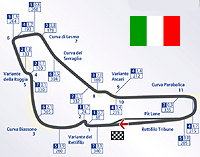
Click on Map to Enlarge

Click on map for a full size version

Circuit History


From the beginning, Monza was an important venue and, from 1922 has hosted the Italian GP almost every year. Indeed, its opening caused members of the Brescia Automobile club to instigate the Mille Miglia. Brescia had lost its previous high status in Italian motor sport with the coming of Monza. There was also ancient rivalry in that Monza is in Piedmont and Brescia is in Lombardy.

This level of passion has long been a feature of Italian racing and is nowhere better experienced than at Monza when Ferrari is present. The word is 'present', not 'racing', the tifosi will turn out by the ten thousand just for testing.

Like many other circuits, Monza has not been a single layout, but a series of more than a dozen layouts which have ranged in length from 1.482 miles to 6.214 miles. The circuit was opened in the Monza Royal Park, near Milan, in 1922 and featured bankings, though these were demolished in 1939. The bankings which featured in some races, 1955-69, were new structures built on the format of the original. Bankings were used for the Italian GP in 1955, '56, '60 and '61, and were last used for racing of any form in 1969 when the concrete became in need of substantial resurfacing and rebuilding.

From 1950 to 1954, the purely road circuit was 3.915 miles long, but the layout was eased, slightly shortened (to 3.571 miles) and made faster for 1957 and 1958. That is not a misprint, the track was made faster and also easier to overtake on.

Between 1962 and 1971 this revised circuit provided an opportunity for high-speed racing with lots of slipstreaming and overtaking. The 1971 Italian GP holds the record for the fastest-ever Formula One race but, emphatically, that is not the same as saying the fastest race for Grand Prix cars. Though you would not know it to listen to some people, that honour remains in the possession of the 1937 Avusrennen.

After 1971, the circuit underwent some revisions to discourage slipstreaming and to lower the average lap speed. chicanes were added in 1976 and, in 1994, the second Lesmo Bend was tightened and the Curve Grande was reprofiled.

Giancarlo Fisichella describes a lap of this historic circuit:

"At the end of the long pit straight, I will be doing around 217 mph (350 kph) in top gear before having to brake hard for the Rettifilo. The chicane is taken in 1st gear, although the first part, taken at 55 mph (90 kph), is somewhat quicker than the second, for which I need to drop down to under 44 mph (70 kph). Accelerating out of the chicane, I enter the Curva Grande in 5th gear, taking 6th midway through the corner. My speed on entry will be around 167 mph (270 kph), and I will exit at around 198 mph (320 kph).

Maximum speed on the straight down to Roggia, the second chicane, will be just under 211 mph (340 kph), the chicane is taken in 2nd gear, the first part at just under 62 mph (100 kph) and the second at around 71 mph (115 kph).

Then follows a short 4th gear straight where I reach up to 160 mph (260 kph) before reaching the first of the Lesmo corners which is taken in 3rd gear at 100 mph (165 kph). I accelerate through in 4th gear to just under 160 mph (260 kph) before dropping down to 3rd gear for the second Lesmo corner which I take at about 95 mph (150 kph).

Another long straight leads me under the famous banking towards the Ascari chicane. I reach 210 mph (335 kph) in 6th gear before dropping to 3rd gear to take the first part of the chicane in at 85 mph (140 kph) and the second at 110 mph (180 kph).

On the back straight before the Parabolica, I reach 210 mph (340 kph) in 4th gear before entering this very long corner, the minimum speed of which is just under 100 mph (160 kph). A good exit is imperative to carry speed on to the main pit straight.

The speed of this track means low downforce for the cars which causes problems in the chicanes as the cars can slip and slide."

Search the PITPASS news:
F1 plans partner programme to rival Olympics
Q&A with Bridgestone's Tetsuro Kobayashi
Barcelona Test Round-Up - Bridgestone
Donington still on target, claim organizers
Ecclestone denies being unreasonable in Montreal dealings
Euro Disney withdraws F1 bid
Deja Vu at Barcelona as Vettel leads the Toro Rossos (with pictures)
Test Times: Barcelona 19-11
Cutting costs the Honda way
Barcelona Test Notes 18/11 - Honda
Vettel quickest on Day 2 (with pictures)
Test Times: Barcelona 18-11
de la Rosa drives Force India-Ferrari
Bernie Ecclestone... medallion man
Brundle confirms BBC role
Hamilton to take on Olympian Hoy at Wembley
Barcelona Test Notes 17/11 - Honda
Toro Rossos lead the way at Barcelona (with pictures)
Test Times: Barcelona 17-11
Ecclestone in no mood to take things easy

More News...

Click here to visit our sponsor Grand Prix Legends 2
Paul Ricard Test Round-Up - DAMS
Rodriguez quickest on Day 2
Test Times: Paul Ricard 12-11
Kobayashi tops afternoon timesheets
Test Times: Paul Ricard 11-11

More News...

Click here to visit our sponsor GP2
Sepang: Nominated Drivers
Sepang Preview: Malaysia
Cronje returns for South Africa
Sepang Preview: Brazil
Sepang Preview: Monaco

More News...

  Click here for the Pitpass RSS Newsfeed