Headlines

Key leaves Sauber
Andrew Green talks about the VJM05
Q&A with Narain Karthikeyan
Q&A with Paul di Resta and Nico Hulkenberg
Force India introduces the VJM05
Ferrari unveils its 2012 contender
Karthikeyan completes 2012 grid
Ferrari cancels launch
Hamilton: Totally focussed
Q&A with Paddy Lowe and Tim Goss
McLaren unveils the MP4-27
Management tweaks at Enstone
Williams to unveil FW34 on Tuesday
Sutil found guilty
Toro Rosso confirms launch details
McLaren denies PURE speculation
Sutil: I am really sorry
Bahrain: Even the locals are concerned
VW linked with F1 again
Lotus designates 2012 chassis the E20
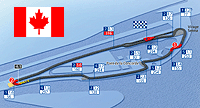
Click on Map to Enlarge

Click on map for a full size version

Circuit History


By 1978 Canada had two things to cheer in Formula One, one was the fact that the Wolf team wore the maple leaf, the other was the fact that Gilles Villeneuve was clearly something very special. There were severe concerns over the safety of the Mosport Park circuit, but it was unthinkable that there would not be a Canadian GP.

In a very short time, a circuit was constructed on a man-made island which had been used in the 1967 Expo. Originally named the Ile Notre Dame circuit, the location is one of the loveliest in Formula One since the narrow track threads its way through lakes and parkland. It is a narrow, medium-fast, 2.75-mile circuit with 13 corners which has changed only in detail from its inception. Some corners were eased for 1979, a new corner before the pits was added in 1991 and a chicane was added in 1994.

It has been a permanent feature on the calendar since 1978, except for 1987 when there was sponsorship dispute between Canada's to largest breweries.

After Gilles Villeneuve was killed in 1982, the circuit was named in his memory.

1995 Canadian GP winner Jean Alesi describes a lap of this demanding circuit:

"Immediately after the start comes one of those overtaking opportunities, under braking for the Senna Chicane. Having said that, it's a tricky manoeuvre. You take this chicane in second, climbing up through the gears to sixth before braking hard and changing down to first for the very tight Island Hairpin.

That's followed by a straight on which you reach around 150 mph (240 kph) before arriving at a chicane (turns 3 and 4), which is half hidden.

Entering the right-hander, you can't see the left-hander which follows it. You take this chicane in second. Then you accelerate hard, taking the fastest corner on the circuit, a right-hander, exiting this at around 150 mph (240 kph) before braking hard for another chicane, Pont de la Concor de which you take in third.

This chicane is crucial because it determines your speed on the straight which follows, where you can reach 185 mph (300 kph) before braking under the bridge.

This is tricky, particularly in the mornings when the track can be very damp. You take this chicane (8-9) in third gear and it is also important because of the following straight where you again reach around 185 mph (300 kph) which leads to the braking area for the Virage du Casino hairpin, the tightest corner on the circuit, which is taken in second.

You can overtake here as well; in fact, this is where most of the overtaking takes place. After the hairpin, you're on the longest straight and fastest part of the circuit where we reach 200 mph (325 kph).

Then we take the final chicane, which can sometimes catch you out, in third gear before crossing the start/finish line.

The proliferation of fast sections means low downforce is the better option, making control round the tight sections more difficult. The brakes certainly take a hammering here as do the tyres."

Search

Search the PITPASS news


Widgets

Discuss on the forum
Post to Facebook
Post to Twitter
RSS Feed
  

  Copyright © Pitpass 2002 - 2012. All rights reserved.

about pitpass | contact pitpass | copyright | privacy & security | rss