|
Instigated in 1929, the Monaco GP has always run through the streets of Monte Carlo, the capital, and most of the territory, of the pocket Principality of Monaco. It has always been a slow circuit, but one which is unusually demanding on both car and driver. The presence of kerbs and walls require the utmost precision and there is very little room for even small mistakes.
One of the men behind the race originally was Louis Chiron, a noted driver with dual French and Monegasque nationality. Chiron last drove at Monaco in 1955, when he was placed sixth and, at 55 years and 276 days, was the oldest driver to start a WC Grand Prix. Chiron continued as Clerk of the Course up to his death in 1979. The narrowness of the track, however, means that overtaking has become exceptionally difficult. The cynical take the view that Monaco continues as a race only because it offers unrivalled glamour and is an invaluable tool when it comes to massaging sponsorship deals. (Photographs from the 1950s show spectators looking decidedly unglamorous wearing headgear made from folded newspapers and knotted handkerchiefs!)
The romantic see Monaco as an overhang from the days when many of the most important races took part round the streets of a town which were given over to racing one weekend every year. Viewed in this way, the race has special historical significance.
There have been small changes to the circuit over the years, but it has retained its essence and frequently provides one of the most absorbing races in the calendar.
Two drivers have managed to finish up in the Monte Carlo harbour: Alberto Ascari in 1955 and Paul Hawkins in 1965 - in neither case was the driver badly hurt. There was a third excursion in the harbour, in the movie, Grand Prix, when Pete Aron (James Garner) dunked his Jordan-BRM.
A lap of Monaco with Giancarlo Fisichella
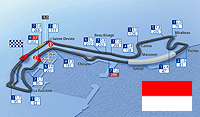
"The lap starts on the pit straight where I will reach over 165 mph (270 kph) in 6th gear, before braking to 2nd gear and around 50 mph (86 kph) for the Sainte Devote corner. From here I accelerate up the long hill reaching about 160 mph (260 kph) before going into the long left-hand 3rd gear comer, Massenet, that leads to the famous Casino corner. I remain in 3rd gear for this and take it at around 75 mph (120 kph) and as I crest the hill the car becomes very light and slides towards the barrier, Then there's a very bumpy, highly cambered straight on which the car reaches around 130 mph (210 kph) and which leads down to the first of the 1st gear hairpins, the Mirabeau hairpin, which is taken at under 45 mph (70 kph.
There's a very short period of acceleration which leads down to the tightest of all the corners at Monaco, the Grand (formerly Loews) hairpin which again is taken in 1st gear and the speed can be as low as 45 kph (30 mph). The downhill stretch leads to Portier which in turn leads in to the Tunnel, both of which are taken in 2nd gear at under 50 mph (80 kph). As you enter the tunnel its quite tricky because you not only have to get used to a change in the ambient light, but there is also quite a difficult corner in the tunnel which is taken at over 155 mph (250 kph) in top gear. On exiting the tunnel braking is very difficult for the chicane as you are heading downhill and have to brake from the maximum speed on the circuit of 280 kph (170 mph) down to around 45 mph (60 kph) and 1st gear for the Harbour Chicane.
From here I will reach around 140 mph (225 kph) before going through the Tabac corner in 4th gear at around 100 mph (160 kph). I remain in 4th gear for the first, fast, part of the Swimming Pool, before braking to 2nd gear and 50 mph (80 kph) for the second part.
The approach to the final hairpin, Rascasse, is very difficult as you have to brake from around 115 mph (185 kph) while still on a curve, down to 35 mph (50 kph) for this 1st gear corner. On exiting this comer it is very difficult to control the wheelspin as you accelerate up to the final corner, Anthony Noghes, which is taken at around 45 mph (75 kph) in 2nd gear. The lap then finishes on the pit straight. "
|