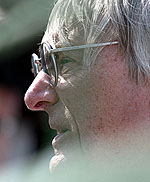
 On Friday, Pitpass ended months of speculation by exclusively revealing that F1 boss Bernie Ecclestone did indeed pay jailed German banker Gerhard Gribkowsky. Earlier in the week prosecutors claimed that Gribkowsky received £27m from someone they named as "Bernard E" and a company owned by the Ecclestone family trust. The F1 boss confirmed this but says he didn't pay the money as a bribe and it wasn't connected to shares in the company which runs F1 as had been reported. Instead it was paid after Gribkowsky threatened to report false allegations about Ecclestone's relationship with his family trust to the UK tax authorities. This revelation by Pitpass' business editor Christian Sylt has got worldwide media coverage but some reporters don't yet seem to understand the key issue.
Ecclestone told Sylt that Gribkowsky's threat of informing the tax authorities came in the "very early days when they were dealing with the trust before it was set up." Accordingly, Ecclestone's lawyers advised him to pay Gribkowsky rather than be faced with three years of legal battles as a result of his allegations.
One F1 sports blogger drew from this the false argument that "the legal profession is well known for its expensive tastes, but three years of legal bills are unlikely to have added up to more than $44 million." Several sports reporters made a similar error which, to be fair, is understandable since this is a complex situation. So, to get to the bottom of the flaw let's start right at the beginning.
The origins of this story actually begin way back in 1985 when Ecclestone got married for the second time. His new wife Slavica, was a Croatian and this fact proved to be significant. A decade after his marriage, interest in F1 soared following the death of Ayrton Senna and the sport's finances exploded. Ecclestone's company Formula One Promotions and Administration was managing the F1 rights and taking a cut. It was big enough for Ecclestone to pay himself an annual salary of £54.9m in 1995 making him the world's highest-paid company boss. However whilst F1's finances were rosy Ecclestone's health was not.
In 1995 Ecclestone turned 65 and suffered from heart problems which culminated in him having a triple bypass four years later. When Ecclestone had his operation Slavica was 41 and had two young children with him. His two concerns were ensuring that his family would be financially secure if he were to die and also ensuring that F1 grew even bigger than it was at the time. Ecclestone's first move helped him achieve both of these aims.
On 19 December 1995, F1's governing body the Fédération International de l'Automobile (FIA) transferred to Ecclestone's company F.O.C.A. Administration (now known as Formula One Management) the rights to F1 for 14 years beginning on 1 January 1997. Ecclestone owned 100% of F.O.C.A. Administration so this gave him 100% control of F1's rights for the first time in history. It is thanks to this move that he has been able to steer F1 to huge commercial success as, unlike some other sports, it has not been run by a committee and this allowed it to make quick decisive decisions.
It also allowed Ecclestone to float or sell his business to generate enough money to ensure his family would be financially secure if he died. Previously this was difficult to do since his company had only managed the rights and not owned them directly. Owning the F1 rights gave F.O.C.A. Administration assets which generated £218.6m in annual revenue in 2007 and in excess of £5.5bn over the lifetime of its 14-year contract with the FIA. These lucrative assets formed the basis of several flotation attempts followed by sales of stakes in the business, most recently to F1's current owner, private equity firm CVC, in 2005.
The sales of stakes in companies which owned F.O.C.A. Administration raised a total of £1.5bn according to Sylt's industry guide Formula Money, and although this gave Ecclestone's family a huge fortune it also raised another problem. Normally in the UK if someone dies their spouse does not pay tax on inheriting money from them. However, because Slavica was Croatian and, by 1995 had not lived in the UK long enough to be domiciled there, she would have had to pay a whopping 40% inheritance tax on any money she received from Ecclestone if he had died.
Ecclestone had a simple solution to this which was moving his shares in F.O.C.A. Administration into an offshore trust in Slavica's name so that she, and the children, would directly receive the money from selling F1. The trust was in the name of Slavica and her children so they would not need to inherit money generated from selling its asset (F1) since they owned it already. So if Ecclestone had died they would not have needed to pay inheritance tax as any other spouse would also be exempt from doing.
As Ecclestone himself told Sylt earlier this year, "I was advised to give the shares because at the time Slavica was non-domiciled because you have to be here 18 years to be domiciled. If I had died during that period, normally a wife could inherit money without paying tax but in that case she would have had to pay tax so the easy way to deal with it was give her the shares."
So on 6 February 1996 Ecclestone transferred his 100% stake in F.O.C.A. Administration to a company called Petara which itself became owned by a company called SLEC (the initials of SLavica ECclestone) and in turn this was owned by Bambino Holdings - the investment vehicle of the offshore trust formed for the benefit of Slavica and his children. However this was just the start of the process. The trust received its first payment in 1999 when SLEC received a loan of £870m secured on the future revenues of F1. This led to the UK tax authorities starting to check that the complex company structure had been set up correctly.



sign in