|
Virgin, like Coca-Cola and McDonald's, is one of those iconic brands that F1 has been seeking to bring on board for as long as one can remember. Finally, in 2009, having been linked with a possible buy-out of the Honda team over the winter, Richard Branson tested the waters by entering into a sponsorship deal with the newly created Brawn GP team.
Although Brawn went on to win both titles, by mid-season it was clear that Virgin was looking elsewhere finally reaching an agreement with Manor Grand Prix which had secured one of three new slots on the 2010 grid.
Manor Grand Prix is the result of a 'marriage' between Manor Motorsport, a British outfit founded by John Booth in 1990, and Wirth Research, the company headed by Nick Wirth former aerodynamicist for March Engineering, founder of the Simtek F1 team and consultant to the FIA.
The youngest-ever Fellow of the Royal Institute of Mechanical Engineers, Wirth is widely regarded as genius. Almost entirely responsible for the beautiful 1989 Leyton House March - the chief designer was Adrian Newey - Wirth also conceived and designed the car's active suspension system.
After March he co-founded Simtek Research with Max Mosley, the aim of the company being to provide top class design, development and research at a realistic price. The company designed an F1 car for BMW in 1990 but the German manufacturer decided to abort the project. Wirth subsequently updated the design and sold it to Andrea Moda for use in the 19992 season.
In 1993, with Mosley having sold his shares in the company following his election as FIA president, Wirth took the decision to build his own car for the 2004 season. With MTV Europe as title sponsor and three-time world champion Jack Brabham a shareholder, Simtek lined up on the grid in Brazil with a total workforce of less than 40.
Its active suspension banned, a manual gearbox, the under-powered Ford HB and a design that was considered cumbersome saw the team struggle, with David Brabham qualifying 26th (and last) for the season opener and teammate Roland Ratzenberger failing to qualify. That said, in the race Brabham brought his car home in twelfth.
There was a slight improvement in the next couple of races, indeed, Ratzenberger finished eleventh in the Pacific GP. However, the dream was to end a few weeks later when the popular Austrian was killed during qualifying for the San Marino GP.
While the sport was coming to terms with the loss of Ratzenberger - the first death during a GP weekend since Riccardo Paletti in Canada 1982 - F1 suffered another dreadful blow the following day when three-time champion Ayrton Senna perished in an accident that still remains unexplained.
The team soldiered on for the rest of the season and even into 1995, but with serious money problems - £6m in debt!!! - and an eleventh-hour pullout down by a potential backer, Wirth finally pulled the plug after the Monaco GP. With the team unable to find a buyer, 48 jobs were lost and its assets were sold at auction.
Between 1996 and 1999, Wirth was chief designer at Benetton, the Englishman taking over from Rory Byrne who had headed to Ferrari with Michael Schumacher and Ross Brawn. After a period as a board member at Benetton Wirth left to form RoboScience a company which was to go on to build a robotic dog.
In 2006, Wirth began work as a consultant to the FIA the Englishman working on the split rear wing concept that the governing body intended introducing in 2008. He subsequently became involved with the Acura LMP programme in the American Le Mans Series concentrating on the new LMP1 class car for the 2009 season. The LMP car was deigned entirely using CFD computer simulation technology which Wirth was to subsequently use in the design of the Manor F1 car.
Over the years Manor Motorsport employed a number of drivers who were to go on to win the Formula One title, including Kimi Raikkonen who won the 2000 Formula Renault 2.0 UK Championship with the team and Lewis Hamilton who won the Formula Renault 2.0 UK Championship in 2003.
Along the way Manor also enjoyed success with Antonio Pizzonia, Marc Hynes and Oliver Jarvis before Booth sold the Formula Renault UK operation in 2007.
Retaining the Manor Motorsport name Booth focussed on the Formula Three Euroseries and over the next few seasons enjoyed a certain degrees of success with drivers such as Lucas di Grassi, Paul di Resta, Kohei Hirate, James Jakes and Sam Bird.
Since its foundation, Manor Motorsport had enjoyed 170 race wins and 19 championship titles… now for the next step.
On 12 June 2009, the FIA announced that Manor Grand Prix had been granted an entry in the 2010 world championship, the Yorkshire outfit having agreed a deal to use Cosworth engines. However, on November 30 when the FIA released the official entry list for the 2010 season. Where one expected to see the name 'Manor Grand Prix' one instead found 'Virgin Racing'.
On 14 December, the day before Virgin was due to host a media event giving details of its team it was revealed that the private equity arm of the Lloyds Banking Group had taken a stake in Virgin Racing. While the deal was 'only' worth £10m - small fry in F1 terms - Lloyds was one of the banks that had been baled out by the British taxpayer, the deal coming just months after the outcry over the Royal Bank of Scotland's (RBS) spending on the sport.
While there was much mystery surrounding the team, especially in terms of who owned it, the racing side of things was equally mysterious with the team revealing at its launch that its 2010 contender would be the first F1 car designed without a windtunnel.
Fact is, Manor/Virgin had come into the sport on the basis of a £30m budget cap being introduced. When the idea was first mooted, Manor, like several other outfits, saw this as their 'golden ticket', their way into the sport. However, amidst the threat of the established teams walking away from the sport, the FIA had to do a quick U-turn. Initially the revised deal would see the big teams regulate their spending while the smaller/new teams which agreed to the budget cap would be given various regulatory advantages in terms of engines and aerodynamics, thereby creating a 'two-tier' championship. However, this too went out the window and the new teams were now looking at budgets of around £100m just to get to the grid.
While some of the proposed new teams cried off, realising that F1 was still well outside their budget, Manor was offered an alternative in Nick Wirth, whose approach was not only revolutionary, but cheaper, greener and - it is claimed - ultimately the way to go technically.
Wirth, who had previously run his own Simtek team in F1, was now pioneering Computational Fluid Dynamics (CFD) technology, a system which sees the car designed and modified entirely on computer. The Englishman had already used the technique with great success in Sports Cars, having designed the Acura, now he was keen to bring the technology to F1. While having no desire to return to F1 as a team owner in his own right, Wirth was only too happy to join forces with Manor/Virgin.
At the team launch on 15 December, Virgin Racing was described as "a new team for a new era", a team which would "combine the firepower of one of the most recognised, respected and exciting brands in the world with a racing team concept that looks to exploit and capitalise upon F1's new economic dawn and the challenges of resource restriction that is redefining the sport."
Richard Branson, John Booth and Wirth all grinned from ear-to-ear as they introduced their drivers - Timo Glock, Lucas di Grassi, Alvaro Parente and Luiz Razia - and management team Alex Tai (Team Principal) and Etienne de Villiers (non-executive Chairman). Less than month later however, Tai was out, replaced as Team Principal by Booth, while Graeme Lowdon was appointed CEO. Parente quit the team just before the car's unveiling while his replacement Andy Soucek left in late August citing a lack of testing opportunities.
Due to the timescale and budget, the VR-01 was, as expected, a fairly conventional design. Furthermore, downforce was poor. Nonetheless, in the early stages of the season it gave the Lotus a run for its money.
However, the big disaster for the team, and Wirth, was the fact that a major error during the design stage meant the fuel tank was too small. In other words, no matter how good its pace or reliability, the car was never going to last a full race distance.
Consequently, the tub was redesigned, the new version with a longer wheelbase, however, Glock didn't get his until Barcelona while di Grassi had to wait until Turkey.
The redesign meant that a planned upgrade for Barcelona, including a new floor and front and rear wings, was delayed until the British Grand Prix, while after that the updates were few and far between. While the longer wheelbase car was initially slower than the original version, this was soon rectified with some aero tweaks.
Reliability was a major issue, indeed, the team only finished 20 times from 36 starts. Then again, the fuel tank fiasco didn't help. Nonetheless, over the course of the season, other than a DNS for Glock in China (engine air pressure) and di Grassi crashing on his way to the grid in Japan, the VR-01 fell victim to failures involving its gearbox, hydraulics, suspension, clutch, track rod, steering and even a broken wishbone.
It wasn't until Barcelona that the team enjoyed its first double finish, albeit both drivers over 3 laps down on the winner, while the best result of the year was 14th in Malaysia (di Grassi) and Japan (Glock). Best qualifying performance was Glock's 16th in Malaysia.
Over the course of the season-ending Abu Dhabi Grand Prix weekend, it was announced that Marussia Motors had acquired a "significant shareholding" in the team, thereby "securing its long-term future and ensuring that it can continue to go from strength to strength in pursuit of its racing ambitions".
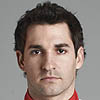
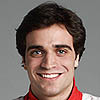
A couple of months later, having revealed Glock and Belgian Jerome d'Ambrosio as its drivers, the team announced a number of changes to its management team, with Nikolay Fomenko, President of Marussia Motors, becoming Engineering Director, Marussia's UK Managing Director, Andy Webb, assuming the position of CEO, Graeme Lowdon now President of Marussia Virgin Racing and Jordan/Force India veteran Ian Phillips, as Chief Operating Officer.
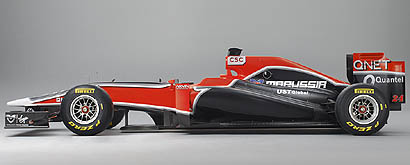
The MVR-02, like its predecessor, was designed by Nick Wirth entirely with CFD (computational fluid dynamics), the addition of the "M" in the car's chassis designation reflecting the team's new owner.
Virgin was one of the few teams that opted not to use KERS, Wirth insisting that the gains offered by the system did not justify the expense in developing it; instead, the team concentrated on improving the car's hydraulics and gearbox, both of which had been the frequent source of problems in 2010. After being forced to re-design the VR-01 when it was discovered the fuel tank was not large enough to finish races with a high fuel consumption, the MVR-02 was designed to be the same length as the original VR-01 chassis whilst retaining the full-size fuel tank. The air intake on the front nose was also designed to resemble that on Marussia's road car, the B2.
The team encountered numerous problems in Australia including rain and the 107% rule, leading to speculation rose up that the car might not race. However, Glock and d'Ambrosio made it through, taking the last slots on the grid. That said, on race day, Glock was forced into the garage for a mechanical failure consequently, having completed less than 90% of the race, he was not classified. Teammate d'Ambrosio finished sixteenth however, the disqualification of both Sauber cars bumped him up to fourteenth.
In Malaysia, d'Ambrosio suffered a mechanical failure during free practice and qualifying was a repeat of Melbourne with the drivers taking twenty-first and twenty-second. In the race, d'Ambrosio retired with an electronic problem while Glock finished sixteenth. In China both drivers finished just one place higher.
Turkey witnessed the team's first upgrade for the season. While Glock was given an 'extreme update' which included a revised floor, new front wing, higher nose and a the team's first stab at a blown exhaust. However, relying on CFD as opposed to the windtunnel, and therefore unable to map the airflow properly, there was little discernable difference.
While d'Ambrosio was to wait until Spain for his update package, the Belgian was faster than Glock for the whole Istanbul weekend. That said, the stewards hit him with a five-place grid penalty for ignoring yellow flags on Friday and consequently he started from twenty-third, while Glock was twenty-first. On the grid, Glock's crew noticed a problem and set about correcting it, however, the repair proved so drawn out that the German ended up not racing, his second unclassified race of the season. D'Ambrosio suffered from no such problems and drove his car home in twentieth.
At Barcelona, the upgrades saw the cars finish nineteenth and twentieth, however in Monaco the MVR-02 was hopelessly of the pace and once again filled the eleventh row on the grid. Things looked promising for the Russian team until Glock suffered a suspension failure, however, d'Ambrosio took fifteenth, bringing the home for another classified finish.
In Canada the pair had enough pace to finish fourteenth and fifteenth, however, it was (HRT driver) Tonio Liuzzi's thirteenth place in Montreal that was to help the Spanish team clinch eleventh place in the final constructors' standings.
It was around this time that the team announced that it was parting company with Nick Wirth, admitting that the reason was due to a disappointing start to its second season. In the months that followed, in addition to establishing a technical collaboration with McLaren, the team recruited former Renault stalwart Pat Symonds to put together a design team.
In Germany the duo qualified twentieth and twenty-second, with Glock ahead of d'Ambrosio. The German had commented to his engineers on the radio that they were making it "difficult for him", however, he subsequently claimed his comments were meant as a joke. 24 hours later, the team announced that it has agreed a new deal with the German, keeping him until 2014. The team went on to finish in seventeenth and eighteenth while in Hungary the duo came home seventeenth and nineteenth.
D'Ambrosio was outside the 107% rule for his home race at Spa. however, he was allowed to race because it had been a mixed weather qualifying. He subsequently brought the car home in seventeenth, one place ahead of his teammate.
Despite out-qualifying and out-racing HRT, the Italian Grand Prix was disappointing for Virgin Qualifying on the penultimate row, d'Ambrosio suffered a gearbox failure on the first lap, and although Glock managed a fifteenth place finish - this was last of the classified finishers.
And so it continued, much to the frustration, not only of the team, its drivers and John Booth, but Pitpass' Mat Coch who began to wonder whether the Marussia Virgin was serious about F1.
"Pre-season I set the team the target of making it through to Q2 on pace, and perhaps steal a point if the wind was in its favour," he wrote. "Neither of these happened which means that to me 2011 was a disappointing year from Virgin, carrying on from an equally disappointing 2010. That shouldn't have happened, and in 2012 it simply cannot continue. No team can afford to languish at the wrong end of the timesheets because eventually they drop off the bottom; Larrousse, Forti, Simtek...
"A lot needs to change then," Coch continued, "and perhaps that first step in the right direction - taking a more traditional approach to car design. The team now has Pat Symonds on board. He's been with the team throughout 2011 and was taken on as a consultant to find areas where the team could improve. His part in Wirth's demise is left for us to speculate over but that change in technical direction may be just what's needed."
In November 2011, the team announced that in 2012 it would be called Marussia F1 Team, while Virgin, who had been title sponsor, confirmed it was staying with the team despite the name change.
With a 60% model of its 2012 car in the McLaren wind tunnel by the end of September, the first parts were being received at the factory in early December. Surprisingly, the team has opted to continue with one strand of Nick Wirth's philosophy - it will not use KERS in 2012, John Booth insisting that the money could be better spent elsewhere.
While d'Ambrosio gave a good account of himself, the team opted to drop him in favour of GP2 graduate Charles Pic, who spent two days testing with the team at the Young Driver Test in Abu Dhabi.
Looking ahead to the new season, Mat Coch sums up the huge improvement that is needed... and why.
"Virgin is officially the worst team in Formula One," he writes. "It has been these last two seasons and that simply has to change. Investors are not interested in doing business with an entity which is not successful. Success breeds success, and while Jim Wright, Marketing Director at Virgin, tells us that the team's finances are built through business-to-business relationships rather than traditional investment, Formula One is an especially fickle business and if you're not winning you're losing. The maths is comparatively simple in that respect."
Statistics - at the end of the 2011 Season
Drivers' Titles: 0
Constructors' Titles: 0
Seasons in F1: 2
Grand Prix: 38
Wins: 0
Poles: 0
Fastest Laps: 0
Best result in 2011: 14th (2 Times)
Best qualifying 2011: 20th (7 Times)
Worst qualifying 2011: 24th (4 Times)
2011: Glock out-qualified D'Ambrosio 14 times
2011: D'Ambrosio out-qualified Glock 5 times
2011: Completed: 1821 out of 2208 laps (82.5%)
2011: Finished 29 times from 37 starts (78.4%)
|