|
From
the end of the war until 1954, the principle German racing series, East and West, was for Formula Two and was dominated by BMW-engined specials. Several of these appeared in World Championship events, 1952-3, mainly in the German GP.
Special mention should be made of Paul Greifzu, a brilliant engineer/driver from East Germany, whose talents were largely unknown in the West. He never competed in a WC event, but it would be negligent to pass him over. Greifzu was killed in early 1952, but his car was entered by his widow in the 1952 and 1953 German GPs.
The design of the BMW 328 engine had been acquired by Bristol Cars as part of war reparations and the anglicised BMW engine was a popular choice for the 2-litre Formula Two. Cooper and Frazer Nash both scored WC points with the Bristol/BMW engine.
Over the years, BMW has enjoyed tremendous success in various forms of motorsport, including motorcycle racing, Touring Cars, hillclimbs, and also won the Le Mans 24 hours in 1999.
BMW first entered Formula One with Brabham in 1982 during the turbo era, and subsequently supplied engines to Arrows, ATS and Benetton, powering Nelson Piquet to the World Championship in 1983.
From 1986 on, BMW toyed with the idea of entering Formula One as a manufacturer and in 1990 built a V12 engine to go into a chassis designed by Simtek. However, this move was quashed by the board of directors and it was not until 2000 that the company returned to Formula One, as engine supplier to Williams.
The relationship with Williams got off to a great start when Ralf Schumacher finished third, behind the Ferraris, at Melbourne, with further podiums at Spa and Monza.
The following year, Ralf Schumacher gave the BMW WilliamsF1 Team its first win, taking a convincing victory at San Marino, with further wins in Canada and Germany, and a maiden win for Juan Pablo Montoya (Monza).
In 2002 and 2003, Williams finished runner up to Ferrari, but there was already evidence that the 'marriage' between the very English chassis manufacturer, and the very German engine supplier, was shaky. BMW Motorsport director, Gerhard Berger, was keen to see the team enter F1 in its own right, but the board of directors stuck to its guns.
Then, things started to go wrong on track, the disastrous 'tusk nose' of the FW26 being a prime example. Also, there was clear evidence of a growing rift as Patrick Head, a man well known for voicing his opinion, hit out at BMW.
In the pitlane it was rumoured that BMW Motorsport director, Mario Theissen, was now attempting to sell the F1 dream to the board of directors, though pitlane cynics believe much of his motivation was due to the fact that the German wanted to be a 'team principal'.
When the statesmanlike Frank Williams publicly criticized BMW, it was obvious that the marriage was at an end, and while some speculated that the Germans might seek an alternative partner, others remained convinced that Theissen had successfully sold his employer on the dream, and possible glory, of establishing a successful F1 team of its own. Consequently, the Bavarian manufacturer bought out Sauber, from neighbouring Switzerland.
Curiously, rather than enter F1 as BMW, the Sauber name was retained, with the team running under the BMW Sauber F1 Team banner.
Having enjoyed success in all other forms of motorsport, all eyes were on the German team. However, Theissen made it clear from the start the team philosophy would be 'softly, softly' with the intention of building a championship winning team over a number of season rather than making wild promises at the outset.
With a cast iron contract from Sauber, Jacques Villeneuve was retained, with Nick Heidfeld moving over from WilliamsF1. Polish sensation Robert Kubica was given the role of reserve driver, with Theissen also keeping a watching eye on former Formula BMW Germany champion, Sebastian Vettel.
In the initial races, the BMW F1.06 package suffered from two problems, the inability of the chassis to work with soft compounds and vibration from the BMW V8.
As the season progressed the team worked on the problems and from San Marino the F1.06 was clearly improving, with the team regularly scoring points. That said, in Melbourne both drivers had come hope in the points with the team scoring eight points in its third race - it took Toyota almost two seasons to score that many.
A crash at Hockenheim left Villeneuve suffering headaches and consequently the Canadian was replaced by Kubica.
Depending on who you believe this is where it all went wrong for the 1997 World Champion. First off, Kubica gave a remarkable performance, and it was only the fact that he was disqualified as a result of his car being underweight that prevented him from scoring a point on his GP debut. Secondly, there is the theory that Theissen, unhappy at having to accept Villeneuve's Sauber contract, now had cause to dump the 35-year-old.
Either way, Villeneuve was dropped, to be replaced by Kubica, with Sebastian Vettel stepping up to the role of third driver.
Kubica's pace lit a fire under Heidfeld's backside, with both of them looking over their shoulders at Vettel, who spent the remainder of the season topping the Friday timesheets.
Finishing fifth in the Constructors' Championship, admittedly fifty points down on Honda, but ahead of Toyota, will have no doubt persuaded Theissen, and more importantly his superiors, that BMW made the right move in going solo.
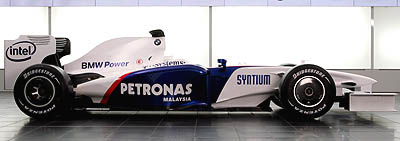
Heidfeld, Kubica and Vettel were all retained for 2007, and much was expected of the new package. Whereas much of the F1.06 had been designed before BMW bought Sauber, the F1.07 was the first genuine F1 car built under the BMW banner.
Speaking at the launch of the team's 2007 contender, Theissen said: "In 2006 we exceeded our own targets. Now expectations are rising faster than the team can develop. That's the punishment for excelling yourself."
2006 had been an excellent debut season for the German team, but ahead of the new season there was widespread anticipation that Williams and Red Bull would show signs of improvement and challenge the newcomers. Many believed that despite the progress made in 2006, the German outfit would have trouble maintaining it.
However, as it happens, BMW continued its X-year plan with typical German efficiency, clearly building upon the foundations lain in 2006.
While the F1.08 was no match for McLaren or Ferrari, it was soon clear that it was 'best of the rest', leaving Renault very much in the shade. Theissen had said, pre-season, that the team's task for 2007 was to halve the gap to the leaders, in practice, the German outfit had done this within the first couple of races.
As it happened, for much of the season, particularly in qualifying, the BMWs were very, very close to the leaders, it was only in the run-in to the season finale that both McLaren and Ferrari began to widen the gap again.
In addition to its highly efficient, and clearly successful, approach to it F1 programme, which included Albert2, its state of the art supercomputer, BMW had two excellent drivers in Nick Heidfeld and Robert Kubica, not forgetting Sebastian Vettel.
There were problems, most notably the early-season gearbox glitches, then there were the hydraulics failures, particularly Kubica's while leading in China. There was also the strategy error at Monaco, to all intents and purposes a clear example of BMW's lack of experience as an entrant.
Heidfeld and Kubica appeared to get along well and kept each other honest throughout the year. At season end however, it was the German who had the upper hand, finishing fifth in the Drivers' Championship, just ahead of his Polish teammate, but amassing twenty-two points more. Quick Nick also claimed the team's two podium finishes.
Kubica took a little longer to adapt to the switch to Bridgestone, even though Albert2 made things a little easier for his team, while there was also that horrendous crash in Canada which saw him ruled out of the race at Indianapolis.
Following the exclusion of McLaren, BMW was second in the Constructors' Championship with almost double the points scored by third placed Renault. However, championship-winning Ferrari had more than double the German team's points.
In 2008, both drivers were retained, with Christian Klien brought in as test driver now that Timo Glock had moved to Toyota.
On paper, 2008 was another successful season for BMW, the Munich-based outfit ticking off another couple of boxes as it kept true to its 'three-year plan'. However, the reality was somewhat different.
Having achieved its self-set goals in 2006 and 2007, the German team did it again in 2008, when Kubica won the Canadian GP, leading home Heidfeld to score an impressive 1-2. However, almost from that moment the team appeared to give in, settling for what it had already achieved.
Suddenly Kubica was leading the World Championship, the team having led the Constructors' Championship earlier in the year, a situation surely beyond their wildest dreams, but rather than up the ante and take the fight to McLaren and Ferrari, BMW appeared to give in. Indeed, having been the third force on the grid in early 2008, by the end of the year the German team was struggling to hold off the opposition.
Whereas most 2008 cars were 'carry-overs' from their 2007 predecessors, the F1.08 wasn't. Willy Rampf described the F1.08 as a "major step forward" and so it was. The German team, with the aid of Albert2, had really gone to town on the aero, resulting in a car that was highly sensitive even by F1's standards.
The F1.08 had a longer wheelbase than its predecessor, yet despite this it was lighter, allowing the team to play around with ballast.
Despite the concentration on all things aero, the F1.08 was best on tracks that didn't require high downforce, whereas it struggled on high downforce tracks unable to generate the required grip.
Stability under braking was much better than the F1.07, a move much appreciated by Kubica, and this was partly due to the huge gurney flap the team often ran. Not the most efficient solution but it suited Kubica, allowing him to attack the entry to corners. Heidfeld, on the hand, struggled, usually in qualifying, unable to get the front tyres up to temperature.
For some strange reason, the were also a number of instances when Kubica lost pace due to over-pressurised tyres, the F1.08 proving particularly sensitive to this. Indeed, in terms of tyres, the F1.08 has a very small performance window and it was almost certainly this that led to some of Heidfeld more uninspiring performances.
In the first half of the season, the F1.08 was up there, and though unable to take on the Ferrari or McLaren head-on, it was clearly in a position to take advantage should things go wrong. However, in the latter stages of the season, despite the introduction of new components, the car had run out of steam and was losing out to Renault, Toyota and even Toro Rosso.
Some put this down to the over complexity of the aero others to the team's inexperience, either way, in the latter stages of the season neither BMW driver was able to take the fight to the front runners, something which must have been particularly galling for Kubica since, following his second place in Japan, he was still in with a chance of snatching the title in much the same was as Kimi Raikkonen a year earlier. No surprise therefore, that as the team continued to focus its concentration on its 2009 car, the Pole made his frustration public.
On reflection, the team might have achieved its self-set goals, but maybe it simply didn't set the benchmark high enough.
In its fourth season, for which Heidfeld, Kubica and Klien were all retained, the German manufacturer, sticking rigidly to its self-set masterplan, was looking to win the title. Even before the season got underway Pitpass said that it couldn't help but feel that this particular target was not going to be met quite as easily as the others. However, little did we know how bad things were to turn out.
While its 2008 season was unravelling, BMW was one of the first teams to turn its attention to 2009 when a raft of new regulations were due to come into effect. The other team that made a conscious decision to focus on the forthcoming season was Honda which, when one considers how things were to turn out, is somewhat ironic.
In late 2008 testing, BMW was the first to run a car with the 2009 spec rear wing a monstrosity that had fans fearing that the new generation of cars would be the ugliest in the sport's history, Adrian Newey subsequently proving such fears were ill-founded.
The main problem as far as BMW was concerned was that dividing the team in two, its HQ in Munich and the factory in Hinwil, was by now doing tremendous damage to the German-Swiss outfit, the two factions involved in the sort of internal political battle normally associated with Maranello in the bad old days. Furthermore, Munich's dogged insistence on pushing ahead with KERS was to have ramifications not only for its own team but for all its rivals in the F1 pitlane.
To further complicate matters, head of engineering and long time Sauber servant Willi Rampf took a sabbatical at the end of 2008 - to be replaced by Walter Riedl - only to return a couple of months later. This was a team in crisis.
Like most of its rivals, BMW missed the boat when it came to the double diffuser however, it was KERS where the German team scored he most spectacular own goal. While around the same weight as the Ferrari and Mercedes units, BMW's KERS system not only affected the car's stability under braking it could not be used for the full (allowable) duration without risking overheating the batteries.
While Heidfeld persevered with the unit a few times, his heavier teammate found it totally unworkable. The team had put everything into its development of the KERS system - pretty much to the cost of most other development, particularly aero - only to find that it was almost useless.
Kubica was looking good for a surprise third in Australia before he got involved in an incident with Sebastian Vettel that would subsequently see the German hit with a grid penalty for the next race. After that however, certainly until the end of the season, it was pretty much slim pickings with Heidfeld securing a fortuitous second in the madness of Malaysia with a couple more points in Spain and Turkey. Ironically, both of these races saw updates to the car, a new aero package for Barcelona and a double diffuser for Istanbul.
At Valencia the team, having finally given up on KERS despite having developed a modified version, introduced a new slimmer version of its car and from the outset the improvement was obvious.
However, by this time BMW had dropped its bombshell, announcing on July 29, three days after the Hungarian GP, that it was to exit the sport at season end. "Resources freed up as a result are to be dedicated to the development of new drive technologies and projects in the field of sustainability" the manufacturer announced with a chilling lack of emotion.
As the Munich based outfit finally began to make progress both in terms of qualifying and race results the rug was pulled from under the team in what some still see as an act of spite, 'we cannot win so we're leaving'.
Between them, in the final seven races of the season, Heidfeld and Kubica scored 28 points, compared to the 8 points scored in the first ten races. In Belgium the BMW duo finished fourth and fifth while in Brazil there was nothing fortuitous about Kubica's second place finish.
While all this was going on, BMW announced that it had reached a deal with a Middle East company called Qadbak and it was Pitpass, courtesy of sources at both Hinwil and Munich that first raised the alarm as to this mysterious outfit. Subsequently, despite ongoing confusion as to how many teams would actually make it to the grid in 2010, BMW announced that a deal had been agreed which would see the team revert to its original owner Peter Sauber.
Over the years BMW has given much to F1 and played a major role in the sport's history, it's so very sad therefore that it has to end this way.
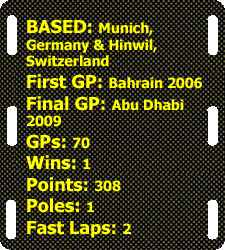
Statistics - at the end of the 2009 Season
Best result in 2009: 2nd (2 times)
Best qualifying 2009: 3rd (Belgium)
Worst qualifying 2009: 19th (2 times)
2009:Kubica out-qualified Heidfeld 10 times
2009:Heidfeld out-qualified Kubica 7 times
2009: Completed 1757 out of 1976 laps (88.9%)
2009: Finished 29 times from 34 starts (85.3%)
|