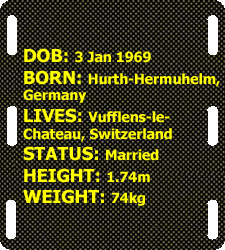
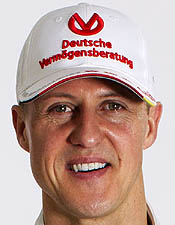
|
Michael made his F1 debut with Jordan at the 1991 Belgian GP after convincing team boss Eddie Jordan that he had experience of the Spa circuit (in fact he had only driven around it on a bicycle!). Having qualified an impressive eleventh, Michael's F1 debut lasted just a few hundred yards before his clutch gave out, however this was more than enough to impress Benetton boss Flavio Briatore who promptly snatched the German driver from the Irish team.
His first victory came at Spa, exactly a year after his debut, and Michael went on to claim his first world title in 1994. A second title came the following year, and Michael moved to Ferrari for 1996 relishing the challenge of making the Italian team world champions again.
Despite his success, controversy has never been far from Schumacher's door, with accusations of bad sportsmanship dating back to his championship battle with Damon Hill in 1994. Michael was involved in a number of incidents during the season, and a collision with Hill in the Australian GP secured him his first world title.
A similar incident in 1997 involved Jacques Villeneuve, but this time Schumacher was forced to retire from the race and the Canadian went on to take the title for Williams. Michael was heavily penalised by the FIA, enduring a one-race ban and losing his second place in that year's championship.
1998 saw Michael again battling for championship glory, this time with McLaren's Mika Hakkinen. The pair took the fight down to the wire at Suzuka, but the German's chances of victory were destroyed when he was forced to start the race from the back of the field having stalled on the grid.
It was clear Ferrari was getting closer to the title however, and high hopes were pinned on Schumacher for the following season. A first lap accident at the British GP put Michael out of contention however, as he was forced to sit out the following six races as he nursed a broken leg.
Michael finally delivered in 2000, winning the Drivers' title in Japan before completing the double a fortnight later. Ferrari were world champions for the first time in 21 years, and Schumacher had finally achieved what at times he must have felt was impossible.
Things got even better the following year, with Michael taking a total of nine victories. The title was wrapped up in Hungary in August, and he went on to break Alain Prost's record for the most number of Grand Prix wins, as well as records for scoring the most victories and points in a single season.
For several years the fear had been that Ferrari would finally produce the best car on the grid and hand it over to arguably the best driver, Michael Schumacher. If this wasn't the case in 2001 then it most definitely was in 2002.
The F2002 was without doubt the class of the field allowing Schumacher, Barrichello and Ferrari to set records that might never be broken.
The German was at one with his car and in return his machinery never let him down, indeed the German not only finished in every race, he completed every lap of every race and finished in the points in all 17 events. It was a tour-de-force and Schumacher relished every moment of it.
Unfortunately as has so often been the case throughout his career there were blemishes on the German's record. In Austria just yards before the finish line, race leader Barrichello slowed to allow Schumacher to take the victory and thus extend his championship lead. The public backlash rocked the sport to its very core.
Then at Indianapolis Schumacher slowed in an effort to recreate the Ferrari finish at Daytona in 1967 when all three cars crossed the line together. Unfortunately Barrichello misread the situation and took the victory.
Despite taking his fifth title, Schumacher and indeed Ferrari appeared to be toying with the public, manipulating the results at will. With the Championship settled mid-season fans found better ways of spending their Sunday afternoons and consequently deserted the sport, seemingly taking the sponsors with them.
In a clear attempt to stifle another runaway season for Michael and Ferrari the FIA introduced a number of controversial new rules for 2003, including a complete overhaul of the points system.
Ferrari described its F2003-GA as the best car it had ever built, but it was soon clear that the Italian team had a serious fight on its hands. At first it was McLaren that challenged the supremacy of the red cars, then, as the season progressed, it was the WilliamsF1s that seemed to be the class of the field.
Schumacher too was under pressure, not only from his brother Ralf and Juan Pablo Montoya in the BMW powered WilliamsF1s but also young pretenders Kimi Raikkonen and Fernando Alonso. Furthermore Bridgestone was clearly struggling against its French rivals resulting in an embarrassing performance in Hungary when Schumacher was lapped by Alonso who went on to become the youngest race winner in F1 history.
The new points system meant that although Kimi Raikkonen had only won one race compared with Michael's six victories, the title fight went down to the wire.
Despite a lacklustre performance Schumacher brought his car home in eighth and thus became the most successful driver in the history of the sport having won six World Championship titles.
Pre-season testing suggested that Michael and Ferrari faced another long struggle in 2004. However, from the opening practice session in Melbourne, it was clear that neither the German nor his team had lost 'the edge'.
Formula One didn't know what had hit it as Michael and Ferrari launched a tour de force that resulted in five straight wins - split by a hiccup in Monaco - and then another seven successive wins.
Once the championship had been wrapped-up, the German eased off - in China alarmingly so, and to a lesser extent in Brazil - however, he took another win in Japan just to prove it could still be done.
It might not have been good for TV viewers, fans of rival teams and drivers, or the British media, but what we were witnessing in 2004 was a phenomenon.
When Ross Brawn announced, at its launch, that the F2005 was the best car that Ferrari had ever built, there was an understandable groan, not merely from the media and race fans, but from almost everyone involved in the sport, for it is doubtful whether F1 could withstand another season of Schumacher/Ferrari domination.
With no disrespect to either Michael or Ferrari, we'll never know how good the F2005 really was, because the new tyre and aerodynamic rules meant that the Italian team struggled.
The F2005 was introduced two races earlier than planned, and at first it looked as though the team had indeed produced another winner, such was its pace at both Sakhir and then Imola. However, these were to prove highlights in a (relatively) poor season.
Yet despite the limitations of the equipment at his disposal, the German gave his all. Yes, there were moments of madness, the attacks on his teammate at Monaco and Indianapolis, not to mention another disastrous weekend in China. However, for the most part, Schumacher was superb, absolutely refusing to surrender.
Whilst McLaren and Renault fought for the titles, Schumacher did his best, with typically superb drives at Imola, Canada, Hungary and Japan, proving that there was life in the old dog yet.
2006 marked Michael's fifteenth full season in F1, and from the outset there was speculation that this might be the year the German finally chose to call it quits. Alonso's move to McLaren in 2007 fuelling talk that Kimi Raikkonen would move to Ferrari, either to replace Schumacher, or, hopefully, form a super-team.
When you are widely regarded as the best it is inevitable that the merest dip in performance will be seen as the beginning of the end, particularly by those within the media who love a sensational headline, or perhaps have a hidden agenda.
Consequently, when Michael could only manage sixth in Malaysia, and spun out of the Australian Grand Prix, despite finishing second at Bahrain, the media decided the writing was on the wall.
The truth is that largely due to the failings of its Bridgestone tyres, Ferrari was struggling. However, clever strategy saw the German win at Imola, reversing the role played out with Alonso in 2005, and again at the Nurburgring.
A sudden change in the weather conditions cost the German victory in Spain, but then, in Monaco, came another of those moments that will forever be used by those who regard him a 'flawed genius'.
Race stewards adjudged Schumacher to have deliberately stopped his car on track in an attempt to bring the qualifying session to an end, thereby preventing Alonso from taking pole position. The German, with the aid of telemetry data, denied this, claiming that his wheels had locked up. Nonetheless, Schumacher was sent to the back of the grid. Once more the German was in the headlines for all the wrong reasons.
Next day he produced a magnificent performance, finishing second, albeit 18s down on his championship rival. The Spaniard took the next two wins before Michael hit back with a trio of victories, thereby keeping his title hopes alive.
While we looked forward to the prospect of a 'down to the wire' title fight, the media concentrated on the German's future, much to the consternation of Jean Todt, who repeatedly said that no decision had been made about Ferrari's line up for 2007 or whether Schumacher would continue racing.
The Italian team finally revealed that its plans for 2007, including the future of Michael Schumacher, would be made after the Italian Grand Prix at Monza. First there was the little matter of the World Championship to think about.
Sadly, the Italian race was clouded in controversy following Alonso's relegation to the back of the grid for an incident involving Ferrari's Felipe Massa. The Spaniard was adjudged to have hindered Massa during qualifying even though almost everyone other than the Brazilian, Todt, Ferrari and the stewards could see that this wasn't so.
To add extra spice to the Monza weekend Alonso's Renault suffered a rare engine failure while Michael took victory, thereby closing the championship gap to just two points. Bernie Ecclestone couldn't have scripted it better.
Michael had barely crossed the finish line when Ferrari revealed - by means of a well prepared press release - that this was the German's final Italian Grand Prix as he was to retire at the end of the season to be replaced by Kimi Raikkonen. The King is dead, long live the King, as it were.
While some tried to take in the significance of the loss of the German, a GP regular for more than fifteen years, others looked forward with anticipation to the three remaining races.
Though he won in China, an engine failure - the first since Indianapolis 2001 - in Japan seemed to signal the end of the German's hopes of an eighth title. Heading to Brazil Alonso led by ten points and the only way Michael could win the title would be to win the race and for Alonso to fail to score a single point. Hardly likely.
Even his final Grand Prix was controversial, the German suffering a technical failure in qualifying which meant he would start the race from the fifth row.
Nonetheless, Michael gave one of the finest performances of his career, and though he could only manage fourth, it was a drive that typified the German's skill and determination.
Sooner or later every reign has to come to an end however, and despite his age, despite the titles, in 2006 Michael proved he still had the hunger and the ability to win. Up until the final lap of his final race he remained remorseless in his quest not just for victories but for every single point he could grab.
The championship over, Ferrari was clearly keen to keep Michael on board and there was talk that the German wanted a role as assistant to Todt who had just been appointed Ferrari CEO.
In early 2007, with his role at Ferrari still undefined, there was talk of Michael taking over as Team Principal, something denied at the time by all concerned. However, in early January 2008 Todt admitted that the German had been offered the position which he subsequently declined.
There were times during 2007, particularly when Raikkonen was going through his 'bad patch' after Melbourne, when some were openly questioning whether Michael had quit too early, and for much of the year there was continued speculation as to whether the German might return to the cockpit.
In November of that year, Patrick Head admitted that he wouldn't be surprised to see McLaren make a shock move for Michael, teaming him with Lewis Hamilton for 2008. Therefore, surely it wasn't entirely co-incidence that saw Ferrari announce - less than 48 hours later - that the German was to test the F2007 at Barcelona.
As the debate continued, Michael proved he had lost none of his flair or pace when he dominated the first two days of testing, subsequently finishing runner-up in the Race of Champions.
While the speculation continued, with Michael insisting that he would not return to F1 as a racer, in December 2007 Pitpass pointed out this didn't mean he might not pop-up elsewhere, representing Germany in A1 GP for example.
Michael continued with Ferrari in 2008 the German, with the full support of Ross Brawn, helping to test and develop the F1car and also doing a lot of work in terms of the company's road cars.
It was around this time also that Michael started racing on two-wheels, contesting a number of rounds of the IDM Superbike series. While keen to play down speculation that he might do a John Surtees in reverse, win a world championship on cars and bikes, Michael admitted that riding a Ducati was the most exhilarating thing he had ever done.
In early 2009, while still performing various tasks for Ferrari, including that of 'racing advisor', Michael also stepped up his efforts on two-wheels, though members of the media and former (F1) rivals remained sceptical. By some any mishap was greeted with undisguised glee however, when the German fell from his bike during a test at Cartagena in Spain in early February few paid any attention far less realised the significance of the incident.
In his role as racing advisor Michael was present at the Hungaroring when Felipe Massa crashed into the tyre barriers during qualifying. Once the full extent of the Brazilian's injury was known, and it was clear that he would not be able to contest the forthcoming race at Valencia, Ferrari turned to the man with whom it had enjoyed so much success just a few years earlier.
What happened next has already been well chronicled, but only Pitpass published the true story.
According to the official line, Michael began testing in a modified 2007 car but suffered pain in his neck after just a few laps, the German and his team pointing to the incident at Cartagena. Consequently, veteran tester Luca Badoer partnered Kimi Raikkonen in the European GP, the Italian's first F1 race in ten years.
The Pitpass version is slightly different however. According to our sources Michael took part in a secret (illegal) test at Mugello when he drove the 2009 car. Climbing out of the car at the end of the session he told the team; " If you think I'm risking my reputation in that piece of s**t you've got to be joking!" Believe who you will, but surely subsequent events bear this out.
Even though Michael was ruled out for any racing role in 2009, for some odd reason later in the year Luca di Montezemolo started talking of the possibility of the German returning to racing were the team allowed to enter three cars. With four new teams due to enter the sport in 2010 nobody really understood where the Ferrari president was coming from. Nonetheless, it appeared the Scuderia saw Michael as part of its long-term plan.
On November 16, Mercedes announced that it had purchased a major stake in the Brawn GP team and that the Brackley outfit would be changing its name to Mercedes GP. Exactly one week later it was announced that the German team had signed Nico Rosberg.
All manner of drivers were linked with the second Mercedes seat, however, nobody took it too seriously when Michael's name started to get tossed about. As time went on however, the speculation continued and more and more people began to wonder if the highly improbable might in fact become reality.
On December 23, as most of us wound down and prepared for the Christmas holiday, Mercedes announced that it had indeed persuaded Michael to come out of retirement, thereby reuniting the German with the company that first brought him into F1 - Mercedes having paid for his Jordan drive back in 1991 - and the man (Ross Brawn) with whom he won all seven of his titles.
Straight after the Christmas break Michael was given special dispensation to test the GP2 Series car due to be used in the 2011 championship. During the three days of the test the only problem the German experienced was in terms of the weather. "The after-effects of that accident are long gone," he said when asked about his neck, "that's why I was sure that it would not cause any problems. This was one year ago, that's over. Now, I am practising since December physically, very carefully and feel extremely fresh and fit.
"That was one of the reasons why I felt so good in the car in Jerez," he added. "But then, Formula 1 is another thing, the g-forces are higher, that's not really comparable. That is why I look forward so much to testing in February. Only then will the old feeling be completely back. I can't wait to be back there."
Though his return in some ways excited, the old order versus the new, there was an overwhelming feeling of 'why?' The German had nothing to prove and in many ways he was in lose-lose situation, if he beat the new kids on the block so what, if he didn't did that indicate that during his era there was often no real opposition?
While many were excited at the prospect of the 'old man' taking on young whippersnappers such as Lewis Hamilton and Sebastian Vettel, there was also great interest in the challenge he faced from across the Mercedes garage where Nico Rosberg had a point to prove. Some predicted that the wily old fox would destroy the young pretender while others opined that it would be Rosberg who would rule the roost.
Initially, the W01 showed a respectable pace, though it was no real match for the McLaren and Red Bull. In the latter half of the season however, the team, having now been surpassed by Ferrari, was under intense pressure from Renault.
In addition to the fact that that the short gearbox - certainly when compared to those on the McLaren, Renault and Ferrari - didn't fully exploit the benefit of the double diffuser, the team was off the ball when it came to the F-duct, the blown diffuser and even its engine cover. Indeed, at times, the team appeared lost, witness the decision to introduce a longer wheelbase car at Barcelona, while the blown diffuser, introduced at Valencia, was then scrapped before being reintroduced.
Overall, the W01 was good on circuits with slow and medium speed corners but lost out in high speed corners due to its lack of downforce.
Finishing sixth in his first race wasn't too bad, the old boy maybe suffering a little 'ring rust'. In Melbourne, having qualified seventh, the German made a great start and was up to third heading into the first corner before being hit by Jenson Button thereby requiring a new front wing. Despite dropping back through the field, Michael made it back into the points but not before spending what appeared to be an inordinate amount of time behind Jaime Alguersuari.
Retiring after just 9 laps in Malaysia as a result of a wheel nut problem, the German finished ninth in China in conditions he once would have revelled in. As the former 'rain master' struggled, finding himself being passed by lesser mortals, some worried that their worst fears had been realised, that it had been a dreadful mistake to come out of retirement. Indeed, Stirling Moss suggested that the 7-time champ was "past it". On the other hand, Damon Hill, a former nemesis of the German, clamed that one should never write him off.
Amidst suggestions that Schumacher was having problems with the narrow front tyres, Jenson Button said the W01 - which would have been the Brawn in which he defended his championship - had been designed for him. Whereas Michael likes a "pointy" car, the Englishman prefers lots of understeer.
As the European phase of the season got underway, the team introduced a longer wheelbase version, whilst also introducing a number of aerodynamic upgrades. Sure enough, in Spain, Michael out-qualified Rosberg for the first time going on to finish a convincing fourth in the race.
In Monaco, not for the first time in his career, Michael was embroiled in controversy. On the final lap of the race, just after the Safety Car had pulled off, the German made a sudden late charge and passed Fernando Alonso halfway through Rascasse to take sixth. Ferrari protested but Mercedes argued that Michael's move was fully legal. However, the race stewards, who included a certain Damon Hill, ruled otherwise and imposed a 20s penalty which dropped him to twelfth. Though Mercedes said it would appeal the decision, it subsequently decided not to. Meanwhile, the FIA later clarified the rules.
In Turkey, Michael qualified fifth and finished fourth, his best result of the season thus far. However, in Valencia he qualified and finished a hugely disappointing fifteenth, the lowest recorded finish of his entire career. That said, like Alonso, the German was the victim of another mix-up over Safety Car rules, the pitlane red light coming on just as he was leaving the pits after Mark Webber's dramatic accident.
There was further controversy in Hungary when Michael, running tenth and under intense pressure from former Ferrari teammate Rubens Barrichello, moved across the track almost forcing the Brazilian into the pit wall. The media had a field day dredging up various other moments from the German's long career. The race stewards were equally unimpressed and subsequently handed the Mercedes driver a 10 place grid penalty for the next race (Spa).
Despite the penalty, which saw him start 21st on the grid, Michael finished 7th at Spa, a circuit which has featured so prominently in his career.
By now Mercedes was struggling, Michael scored points in Italy, Japan, Korea and Brazil before ending the season in dramatic style in Abu Dhabi, the German a victim of a chain of events set in motion when his teammate nudged him going through Turn 6 on the opening lap. Michael's car spun around leaving the German stranded in the middle of the track facing the oncoming field. Unsighted, and with nowhere to go, Tonio Liuzzi went into and over the Mercedes narrowly missing Schumacher's head. The German later admitted that the incident had been "frightening".
Finishing the season ninth, his worst placing since 1991 when he only contested six races, for the first time ever he had failed to score a single win, pole or fastest lap.
Despite intense speculation, Michael was back on the grid in 2011, once again partnering Rosberg, as Mercedes continued with its three-year master-plan.
Speaking at Ferrari's pre-season media event, Fernando Alonso said he believed the biggest threat would come from the seven-time champ. "If the car is right, he will be a contender that we will fear most," said the Spaniard. While there were some excellent performances, Fernando had nothing to fear.
After an inauspicious start in Melbourne, where he was forced into retirement following an earlier clash with Jaime Alguersuari, Michael opened his, and his team's points account in Malaysia when he finished ninth.
A problem with his DRS meant he only qualified fourteenth in China, however, a strong performance saw him work his way up to eighth by the finish.
There was another decent points finish in Spain, but in Monaco, despite out-qualifying teammate Rosberg for the first time, a poor start saw him drop back to tenth. Despite a great battle with Lewis Hamilton, which saw the German make a great move on the McLaren driver at the hotel hairpin, his race came to an early end as a result of an engine problem.
Canada was the scene of Michael's arguably best performance since his return, the German, revelling in the wet conditions, running as high as second at one stage. However, as the rain stopped and the track dried he was unable to fend off Jenson Button and then Mark Webber, ultimately crossing the line in fourth.
At Valencia he collided with Vitaly Petrov, with whom he'd been involved in an incident in Turkey, while in Britain, following a clash with Kamui Kobayashi, Michael was handed a stop-and-go penalty for causing the collision. Nonetheless, he went on to finish ninth.
Following a points finish in Germany and gearbox failure in Hungary, Michael headed to Spa where he would celebrate twenty-years since his Grand Prix debut.
A problem with a loose wheel in qualifying meant Michael was forced to start from the very back of the grid. However, a superb performance, typified by a brilliant opening lap, saw the German bring his car home a very convincing fifth, ahead of his teammate.
He was impressive again in Italy, where he enjoyed a remarkable battle with Lewis Hamilton for fourth place. As he defended his position against the faster McLaren, there were claims that Schumacher was leaving the youngster insufficient room to overtake, indeed, there were even a couple of mild warnings from team boss Ross Brawn. Though he was unable to hold Hamilton off and eventually finished fifth, there was no doubting that Michael was having the time of his life.
After retiring in Singapore following a clash with Sergio Perez, Michael finished sixth in Japan having led three laps of the race - thereby becoming the oldest driver to lead a race since Jack Brabham in 1970.
In Korea, Michael was again looking good for a points finish when he was hit from behind by Petrov, forcing both drivers to retire. In India, having qualified twelfth as he struggled with vibrating tyres, Michael made up three places on the opening lap, eventually finishing fifth ahead of his team-mate.
In Abu Dhabi, the German, having qualified eighth, had moved up to sixth, ahead of his teammate, in the first few corners. When Rosberg eventually passed Michael it effectively settled their standings in the Drivers' Championship, the result compounded when the seven-time champ collided with Bruno Senna in the early stages of the season finale.
After the criticism of 2010, the feedback was a lot more positive by the end of 2011, with no talk of Michael taking up his pipe and slippers. While he continued to lose out to his teammate in qualifying, the 42-year-old usually gave a good account of himself on Sunday afternoons.
There were no podiums, and quite a few needless incidents, however, on the whole Michael gave as much as could be reasonably expected under the circumstances - the MGP WO2 was no race winner.
With Aldo Costa, Geoff Willis and Bob Bell now on board, much was expected from Mercedes in 2012, and while the German manufacturer did score its first win since 1955 overall it was a season to forget for the German team.
That it failed to score a single point in five successive races at the end of the season, losing out to Lotus and under pressure from Sauber, just about says it all, and one wonders how the suits in Stuttgart must be feeling.
Having seemingly conquered the problem with overheating tyres that first appeared in pre-season testing, the German outfit was completely mystified when the problem reappeared later in the year. Then there was the questionable merit of it much trumpeted double DRS device.
Thirteenth in the final standings, his worst championship result since he entered the sport, the German finished just thirteen of the races he started, just 81% of the 1192 laps that comprised the 2012 season. In one particularly lean spell at the end of the season, Michael failed to score points in six successive races.
That's what the record book will show. However, in reality, 2012 was probably Michael's best season since his return.
In Monaco he took a well deserved pole however, the penalty he carried over from Spain, where he collided with Bruno Senna, meant he dropped five places. A couple of weeks later he finally made it on to the podium for the first time since his 2010 return to the sport, thereby becoming the oldest driver to achieve a podium since Jack Brabham's second place at the 1970 British Grand Prix.
That he out-qualified his teammate ten times demonstrates that he still had the pace however, the shortcomings of his car, not least its unreliability, frequently meant all the hard work on Saturday afternoons was to no avail.
Even when Mercedes announced the German was retiring for the second time, making way for Lewis Hamilton, he continued to push, bringing his run of no-points finishes to an end with a storming drive to seventh in Brazil.
It wouldn't be Michael Schumacher if there wasn't some controversy and a couple of stupid incidents, particularly Singapore where he ran into the back of the hapless Jean-Eric Vergne, guaranteed further column inches in the media.
In the eyes of many, Michael "tainted" his legacy by returning to the sport, some claiming that the three years with Mercedes when he was up against a number of top talents as opposed to the one or two during his golden era proved the worthlessness of his many titles.
However, Michael's career wasn't just about the seven titles. It was about the years, particularly those first few at Ferrari, when he didn't have the best car yet still gave 100% and extracted the same from his team.
It was about his speed, his ruthlessness, his ability to read situations and his ability to motivate his team.
While his second coming might not have added much silverware to the cabinet, right to the end the German was clearly enjoying himself and clearly far more relaxed and at ease than first time around.
Days after the end of the season he partnered Sebastian Vettel in the Race of Champions, the German duo winning the Nations Cup for the sixth successive year. Michael, grinning ear to ear, looked just as sharp and eager as he ever did. We wish him a long and happy retirement. He deserves it.
Statistics - at the end of 2012 Season
Drivers' Titles: 7
Seasons in F1: 18
Grand Prix: 306
Wins: 91
Poles: 69
Fastest Laps: 77
Best result in 2012: 3rd (Europe)
Best qualifying 2012: Pole (Monaco)
Worst qualifying 2012: 18th (Bahrain)
2012: Out-qualified Nico Rosberg 10 times
2012: Out-qualified by Nico Rosberg 10 times
2012: Completed 966 out of 1192 laps (81%)
2012: Finished 13 times from 20 starts (65%)
|